Laravel Service Container and Dependency Injection: Complete Helpful Guide with Examples (2026)
LaravelSep 19, 2026
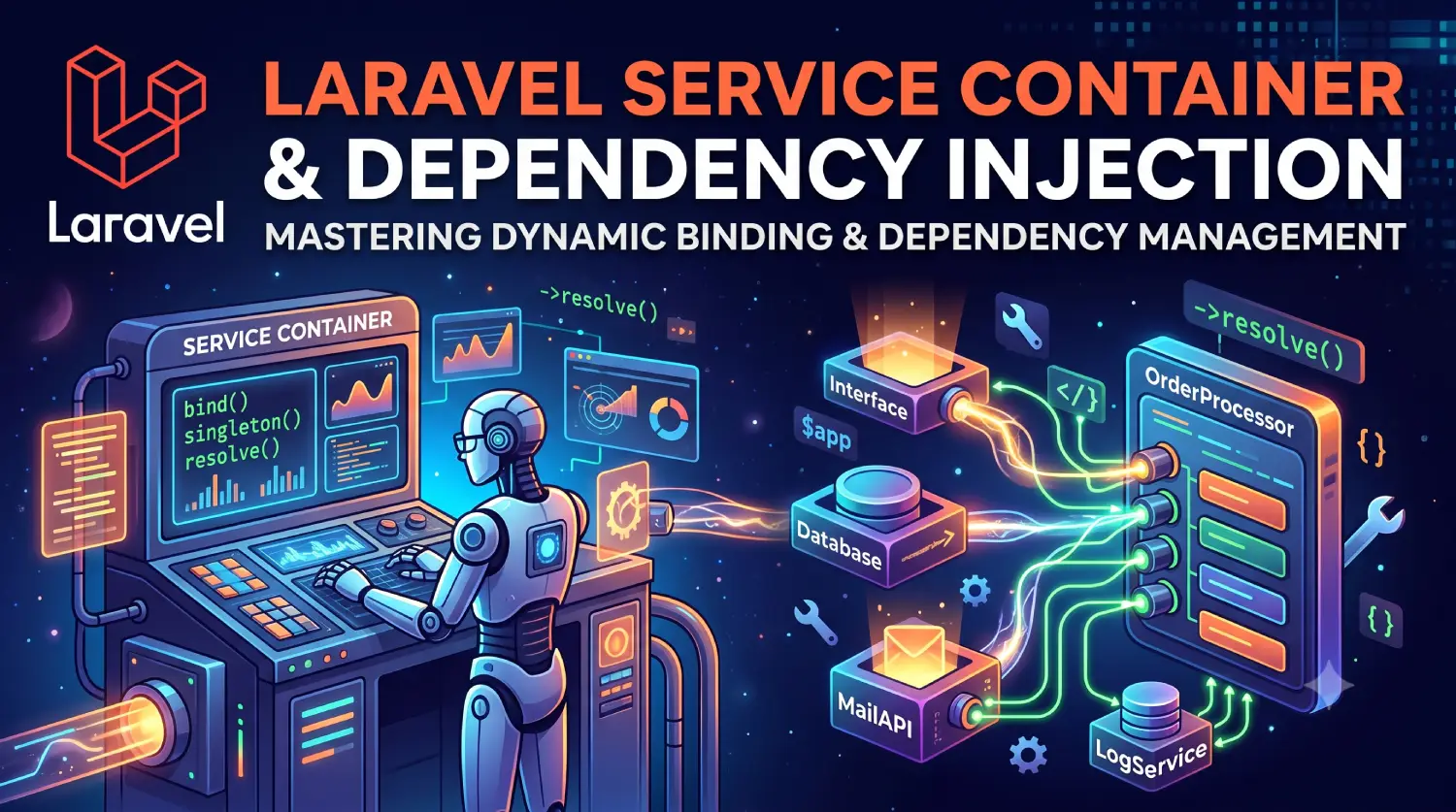
If you are learning Laravel or preparing for a Laravel/PHP developer interview, understanding the Laravel Service Container and Dependency Injection is essential. These concepts are not only used by Laravel internally but also help you write applications that are easier to maintain, test, extend, and scale.
Table of Contents
Laravel is well known for its clean syntax, expressive APIs, and powerful architecture. One of the important features behind Laravel’s flexibility is the Service Container.
In simple terms, Laravel’s Service Container helps manage class dependencies and allows Laravel to automatically resolve those dependencies when an object is created.
For example, instead of manually creating a Laravel dependency injection:
class OrderController
{
    public function store()
    {
        $paymentService = new PaymentService();

        // Process payment...
    }
}
Laravel allows you to inject the dependency:
class OrderController
{
    public function __construct(
        protected PaymentService $paymentService
    ) {
    }

    public function store()
    {
        $this->paymentService->process();
    }
}
Laravel can automatically create PaymentService and inject it into OrderController.
This article explains the Laravel Service Container and Dependency Injection from beginner to advanced level, with practical examples.
What is Laravel Dependency Injection?
Laravel Dependency Injection (DI) is a software design technique where an object’s required dependencies are provided from outside instead of being created inside the object.
Consider this example:
class OrderService
{
    public function process()
    {
        $paymentService = new PaymentService();

        return $paymentService->pay();
    }
}
Here, OrderService creates PaymentService itself.
This creates a strong dependency between the two classes.
A better approach is:
class OrderService
{
    public function __construct(
        protected PaymentService $paymentService
    ) {
    }

    public function process()
    {
        return $this->paymentService->pay();
    }
}
Now PaymentService is injected into OrderService.
The responsibility for creating the dependency is moved outside the class.
This makes the code more flexible and easier to test.
What is Laravel Dependency Inversion?
Dependency Inversion is one of the five SOLID principles.
The basic idea is:
High-level classes should depend on abstractions rather than concrete implementations.
For example, avoid:
class OrderService
{
    public function __construct(
        protected StripePaymentService $paymentService
    ) {
    }
}
Instead, define an interface:
interface PaymentGatewayInterface
{
    public function pay(float $amount): bool;
}
Then implement it:
class StripePaymentService implements PaymentGatewayInterface
{
    public function pay(float $amount): bool
    {
        // Stripe payment logic
        return true;
    }
}
Now the service depends on the interface:
class OrderService
{
    public function __construct(
        protected PaymentGatewayInterface $paymentGateway
    ) {
    }

    public function process(float $amount): bool
    {
        return $this->paymentGateway->pay($amount);
    }
}
This is where Laravel Service Container becomes extremely useful.
Laravel can be configured to understand:
PaymentGatewayInterface
        ↓
StripePaymentService
Whenever Laravel needs PaymentGatewayInterface, it can provide StripePaymentService.
What is the Laravel Service Container?
The Laravel Service Container is a powerful tool used to manage class dependencies and perform Laravel dependency injection.
You can think of the container as a centralized dependency manager.
For example:
class OrderService
{
    public function __construct(
        protected PaymentService $paymentService
    ) {
    }
}
When Laravel needs to create:
OrderService
it sees that the class requires:
PaymentService
Laravel’s container attempts to resolve PaymentService automatically.
Conceptually:
Laravel needs OrderService
        ↓
OrderService requires PaymentService
        ↓
Container resolves PaymentService
        ↓
PaymentService is injected
        ↓
OrderService is created
This process is called dependency resolution.
Why Does Laravel Need a Service Container?
A small application can work without a sophisticated dependency management system.
For example:
$service = new PaymentService();
But large applications may contain hundreds of classes and dependencies.
Imagine:
OrderController
    ↓
OrderService
    ↓
PaymentGateway
    ↓
StripeClient
    ↓
HttpClient
    ↓
Logger
    ↓
Configuration
Manually creating every dependency becomes difficult.
Laravel’s container manages this dependency graph.
It provides several benefits:
- Automatic dependency resolution
- Loose coupling
- Interface-based architecture
- Easier testing
- Easier replacement of implementations
- Centralized configuration
- Cleaner application architecture
- Better support for SOLID principles
How Laravel Dependency Injection Works in Laravel
Laravel supports several forms of Laravel dependency injection.
The most common are:
- Constructor injection
- Method injection
- Interface injection through Laravel container bindings
The most commonly recommended approach is constructor injection.
Automatic Dependency Resolution
Laravel can automatically resolve many concrete classes without explicitly registering them.
Consider:
class PaymentService
{
    public function pay()
    {
        return 'Payment successful';
    }
}
Now:
class OrderService
{
    public function __construct(
        protected PaymentService $paymentService
    ) {
    }
}
You don’t necessarily need to manually bind PaymentService.
Laravel can inspect the constructor and determine what needs to be injected.
This is called zero-configuration resolution.
Constructor Injection
Constructor injection means dependencies are provided through the class constructor.
Example:
class UserService
{
    public function __construct(
        protected UserRepository $repository
    ) {
    }

    public function getUser(int $id)
    {
        return $this->repository->find($id);
    }
}
Laravel automatically resolves UserRepository if it is a resolvable concrete class.
With modern PHP, constructor property promotion makes this especially clean:
public function __construct(
    protected UserRepository $repository
) {
}
Instead of:
protected UserRepository $repository;

public function __construct(UserRepository $repository)
{
    $this->repository = $repository;
}
Method Injection
Laravel can also inject dependencies into methods.
For example:
class ReportController
{
    public function generate(ReportService $reportService)
    {
        return $reportService->generate();
    }
}
Laravel resolves ReportService automatically when the method is called through Laravel’s dependency-aware mechanisms.
Method injection is useful when a dependency is required only by a particular method.
However, if the dependency is required by multiple methods of the class, constructor injection is usually cleaner.
Laravel Dependency Injection in Controllers
Controllers are one of the most common places where Laravel dependency injection is used.
Example:
namespace App\Http\Controllers;

use App\Services\OrderService;

class OrderController extends Controller
{
    public function __construct(
        protected OrderService $orderService
    ) {
    }

    public function store()
    {
        return $this->orderService->createOrder();
    }
}
Laravel creates the controller and resolves OrderService.
This keeps the controller focused on handling HTTP requests rather than constructing application services.
Dependency Injection in Services
Dependency injection is not limited to controllers.
Services can depend on other services.
Example:
class InvoiceService
{
    public function __construct(
        protected PdfService $pdfService,
        protected MailService $mailService
    ) {
    }

    public function generate()
    {
        $pdf = $this->pdfService->create();

        $this->mailService->send($pdf);

        return true;
    }
}
The container builds the dependency tree automatically.
Binding Classes into the Container
Sometimes Laravel cannot determine which implementation should be used.
For example:
interface PaymentGatewayInterface
{
    public function pay(float $amount): bool;
}
There may be several implementations:
class StripePaymentGateway implements PaymentGatewayInterface
{
    // ...
}
and:
class PayPalPaymentGateway implements PaymentGatewayInterface
{
    // ...
}
Laravel cannot guess which implementation you want.
You therefore register a binding.
Using bind()
A basic binding looks like:
$this->app->bind(
    PaymentGatewayInterface::class,
    StripePaymentGateway::class
);
Now whenever Laravel needs:
PaymentGatewayInterface
it resolves:
StripePaymentGateway
For example:
class OrderService
{
    public function __construct(
        protected PaymentGatewayInterface $paymentGateway
    ) {
    }
}
Laravel effectively performs:
new OrderService(
    new StripePaymentGateway()
);
without you manually writing that code.
Using singleton()
Sometimes you want the same instance to be reused.
Use:
$this->app->singleton(
    PaymentGatewayInterface::class,
    StripePaymentGateway::class
);
A singleton binding tells Laravel to resolve the service once and reuse the same instance for subsequent resolutions within the relevant application lifecycle.
Example:
$this->app->singleton(ApiClient::class, function ($app) {
    return new ApiClient(
        config('services.example.base_url')
    );
});
This can be useful for services where creating multiple instances is unnecessary or where shared state/configuration is intended.
Using scoped()
Laravel also provides scoped bindings.
Example:
$this->app->scoped(
    SomeService::class,
    function ($app) {
        return new SomeService();
    }
);
A scoped binding is useful when an object should be shared during a particular application lifecycle, while not remaining globally shared across multiple long-running requests or jobs.
This distinction is particularly important when using long-running application servers.
Using instance()
You can register an existing object instance:
$client = new ApiClient();

$this->app->instance(ApiClient::class, $client);
Whenever the container resolves:
ApiClient::class
it receives the registered instance.
This can also be useful in testing.
Contextual Binding
Sometimes the same interface needs different implementations depending on which class is requesting it.
For example:
OrderService → Stripe
SubscriptionService → PayPal
Both services may depend on:
PaymentGatewayInterface
Contextual binding lets Laravel provide different implementations based on the consumer.
Conceptually:
$this->app->when(OrderService::class)
    ->needs(PaymentGatewayInterface::class)
    ->give(StripePaymentGateway::class);
And:
$this->app->when(SubscriptionService::class)
    ->needs(PaymentGatewayInterface::class)
    ->give(PayPalPaymentGateway::class);
This is especially useful in larger applications.
Binding Primitive Values
The container can also resolve primitive values through contextual bindings.
Suppose:
class ApiClient
{
    public function __construct(
        protected string $baseUrl
    ) {
    }
}
Laravel cannot automatically determine which string should be passed.
You can configure it:
$this->app->when(ApiClient::class)
    ->needs('$baseUrl')
    ->giveConfig('services.api.base_url');
Now Laravel knows where the value should come from.
Resolving Dependencies Manually
Although automatic Laravel dependency injection is preferred, you can manually resolve classes from the container.
For example:
$service = app(PaymentService::class);
You can also use:
$service = app()->make(PaymentService::class);
Both approaches ask Laravel’s container to resolve the class.
Using make()
The container’s make() method can resolve a class:
$paymentService = app()->make(PaymentService::class);
You can also access the container through:
resolve(PaymentService::class);
These approaches are useful when you genuinely need dynamic resolution.
However, manually calling app() everywhere can hide dependencies.
Prefer constructor injection when the dependency is known ahead of time.
Using app()
Laravel provides the app() helper.
For example:
$service = app(PaymentService::class);
You can also access the container:
$container = app();
Then:
$service = $container->make(PaymentService::class);
For normal application code, constructor injection is generally easier to understand and test.
Laravel Service Providers and the Container
Laravel Service Providers are one of the main places where Laravel applications register services and configure the container.
A service provider typically contains:
public function register(): void
{
    //
}
and:
public function boot(): void
{
    //
}
Laravel Container bindings normally belong in the register() method.
For example:
public function register(): void
{
    $this->app->bind(
        PaymentGatewayInterface::class,
        StripePaymentGateway::class
    );
}
The register() method should primarily be used for container registrations.
The boot() method is intended for functionality that should run after service providers have been registered.
Creating a Custom Service Provider
For a larger application, you may create a dedicated provider.
For example:
app/
├── Providers/
│   └── PaymentServiceProvider.php
├── Services/
│   └── OrderService.php
└── Contracts/
    └── PaymentGatewayInterface.php
A provider could contain:
namespace App\Providers;

use Illuminate\Support\ServiceProvider;
use App\Contracts\PaymentGatewayInterface;
use App\Services\StripePaymentGateway;

class PaymentServiceProvider extends ServiceProvider
{
    public function register(): void
    {
        $this->app->bind(
            PaymentGatewayInterface::class,
            StripePaymentGateway::class
        );
    }

    public function boot(): void
    {
        //
    }
}
This keeps dependency configuration organized.
Practical Payment Gateway Example
Let’s build a realistic example.
Suppose an e-commerce application supports:
- Stripe
- PayPal
First create an interface:
namespace App\Contracts;

interface PaymentGatewayInterface
{
    public function pay(float $amount): bool;
}
Now create the Stripe implementation:
namespace App\Services;

use App\Contracts\PaymentGatewayInterface;

class StripePaymentGateway implements PaymentGatewayInterface
{
    public function pay(float $amount): bool
    {
        // Stripe API integration

        return true;
    }
}
Create a PayPal implementation:
namespace App\Services;

use App\Contracts\PaymentGatewayInterface;

class PayPalPaymentGateway implements PaymentGatewayInterface
{
    public function pay(float $amount): bool
    {
        // PayPal API integration

        return true;
    }
}
Now bind the interface:
$this->app->bind(
    PaymentGatewayInterface::class,
    StripePaymentGateway::class
);
Then inject the interface:
class OrderService
{
    public function __construct(
        protected PaymentGatewayInterface $paymentGateway
    ) {
    }

    public function checkout(float $amount): bool
    {
        return $this->paymentGateway->pay($amount);
    }
}
The OrderService doesn’t know whether Stripe or PayPal is being used.
It only knows about:
PaymentGatewayInterface
This is a major benefit of dependency inversion.
Interface-Based Laravel Dependency Injection
Interface-based Laravel dependency injection is particularly valuable in enterprise applications.
Without an interface:
class OrderService
{
    public function __construct(
        protected StripePaymentGateway $gateway
    ) {
    }
}
The service is tightly coupled to Stripe.
With an interface:
class OrderService
{
    public function __construct(
        protected PaymentGatewayInterface $gateway
    ) {
    }
}
You can change the implementation without changing OrderService.
For example:
PaymentGatewayInterface
        │
        ├── StripePaymentGateway
        ├── PayPalPaymentGateway
        └── RazorpayPaymentGateway
This architecture becomes very useful when building applications that support multiple payment providers.
Laravel Dependency Injection with Laravel Repositories
A common Laravel architecture uses repositories.
Define:
interface UserRepositoryInterface
{
    public function find(int $id);
}
Implementation:
class UserRepository implements UserRepositoryInterface
{
    public function find(int $id)
    {
        return User::find($id);
    }
}
Register the binding:
$this->app->bind(
    UserRepositoryInterface::class,
    UserRepository::class
);
Then:
class UserService
{
    public function __construct(
        protected UserRepositoryInterface $repository
    ) {
    }

    public function getUser(int $id)
    {
        return $this->repository->find($id);
    }
}
This provides an abstraction between the application service and data-access implementation.
However, don’t introduce repositories automatically for every Eloquent model. Use them when they solve a real architectural problem.
Laravel Dependency Injection in Jobs
Laravel jobs can also receive dependencies.
For example:
class SendInvoiceJob implements ShouldQueue
{
    public function handle(InvoiceService $invoiceService): void
    {
        $invoiceService->send();
    }
}
Laravel resolves the dependency when executing the job.
This allows jobs to remain focused on the work they need to perform.
Laravel Dependency Injection in Middleware
Middleware can also use constructor injection.
Example:
class CheckSubscription
{
    public function __construct(
        protected SubscriptionService $subscriptionService
    ) {
    }

    public function handle($request, Closure $next)
    {
        if (! $this->subscriptionService->isActive()) {
            abort(403);
        }

        return $next($request);
    }
}
Laravel resolves the middleware dependency through the container.
Dependency Injection in Event Listeners
Listeners frequently use services.
Example:
class SendWelcomeEmail
{
    public function __construct(
        protected MailService $mailService
    ) {
    }

    public function handle(UserRegistered $event): void
    {
        $this->mailService->sendWelcomeEmail(
            $event->user
        );
    }
}
This keeps event listeners clean and testable.
Dependency Injection in Console Commands
Laravel Artisan commands can also use dependencies.
For example:
class GenerateReports extends Command
{
    public function handle(ReportService $reportService): int
    {
        $reportService->generate();

        return self::SUCCESS;
    }
}
Laravel resolves ReportService when executing the command.
Laravel Service Container vs Facades
Laravel developers often encounter both dependency injection and facades.
For example:
Cache::put('key', 'value');
This is a facade.
Dependency injection would look like:
public function __construct(
    protected CacheManager $cache
) {
}
Both approaches are valid, but they serve different purposes.
Facades
Facades provide a convenient static-looking interface to services managed by Laravel.
Example:
Log::info('Order created');
Dependency Injection
Dependency injection makes dependencies explicit:
public function __construct(
    protected OrderService $orderService
) {
}
For your own application services, constructor injection is often a good default.
Dependency Injection vs Manual Instantiation
Consider:
class OrderService
{
    public function process()
    {
        $payment = new StripePaymentGateway();

        return $payment->pay(100);
    }
}
Problems include:
- Tight coupling
- Harder testing
- Difficult replacement
- Hidden dependencies
Instead:
class OrderService
{
    public function __construct(
        protected PaymentGatewayInterface $paymentGateway
    ) {
    }

    public function process()
    {
        return $this->paymentGateway->pay(100);
    }
}
Now the dependency is explicit and replaceable.
Testing Dependency Injection
One of the biggest advantages of dependency injection is easier testing.
Suppose:
interface PaymentGatewayInterface
{
    public function pay(float $amount): bool;
}
During a test, you don’t necessarily want to call a real payment provider.
You can provide a mock implementation.
For example:
$gateway = Mockery::mock(PaymentGatewayInterface::class);

$gateway
    ->shouldReceive('pay')
    ->once()
    ->with(100)
    ->andReturn(true);

$service = new OrderService($gateway);

$result = $service->process(100);
The real payment API is never called.
This makes unit tests faster, safer, and more predictable.
Common Laravel Service Container Mistakes
1. Using app() Everywhere
This:
$service = app(PaymentService::class);
is convenient.
But if every class resolves dependencies manually, the code becomes harder to understand.
Prefer:
public function __construct(
    protected PaymentService $paymentService
) {
}
when the dependency is known.
2. Binding Every Concrete Class
You don’t need to manually bind every concrete class.
If Laravel can automatically resolve a concrete class, explicit binding may be unnecessary.
For example:
class EmailService
{
}
and:
class UserService
{
    public function __construct(
        protected EmailService $emailService
    ) {
    }
}
Laravel can generally resolve this automatically.
Use explicit bindings when you need configuration, interfaces, alternative implementations, or lifecycle control.
3. Depending Directly on Implementations
Avoid unnecessary coupling:
protected StripePaymentGateway $gateway;
when your business logic only needs:
protected PaymentGatewayInterface $gateway;
Interfaces are useful when multiple implementations or testing substitutions are expected.
4. Putting Application Logic in Service Providers
Service providers should primarily configure services and application bootstrapping.
Avoid turning them into large business-logic classes.
5. Overengineering
Not every class needs:
Controller
    ↓
Service
    ↓
Repository
    ↓
Repository Interface
    ↓
Manager
    ↓
Manager Interface
If an application is simple, this can add unnecessary complexity.
Use abstractions where they provide meaningful benefits.
Laravel Service Container Best Practices
Prefer Constructor Injection
Good:
public function __construct(
    protected OrderService $orderService
) {
}
This clearly communicates dependencies.
Depend on Interfaces When Appropriate
Good:
public function __construct(
    protected PaymentGatewayInterface $gateway
) {
}
This makes implementations replaceable.
Keep Bindings Organized
For example:
$this->app->bind(
    PaymentGatewayInterface::class,
    StripePaymentGateway::class
);
Keep related bindings in an appropriate service provider rather than scattering them throughout the application.
Use singleton() Carefully
Use singleton when sharing one instance is actually desirable.
Don’t automatically make every service a singleton.
Stateless services often don’t need singleton registration.
Use Contextual Binding for Different Implementations
When multiple consumers require different implementations, contextual binding can keep the configuration explicit.
Prefer Automatic Resolution
Don’t create unnecessary Laravel container bindings for classes Laravel can already resolve.
How the Laravel Container Helps with SOLID
The Laravel Service Container works particularly well with SOLID principles.
Single Responsibility Principle
Classes can focus on one responsibility instead of creating and configuring their dependencies.
Open/Closed Principle
You can introduce a new implementation without modifying consumers.
Liskov Substitution Principle
Implementations can satisfy the same interface contract.
Interface Segregation Principle
Classes can depend on small, focused interfaces.
Dependency Inversion Principle
High-level classes can depend on abstractions rather than concrete implementations.
This is one reason the Laravel Service Container is an important part of Laravel’s architecture.
A Complete Example
Let’s combine the concepts.
Step 1: Create the interface
namespace App\Contracts;

interface NotificationServiceInterface
{
    public function send(string $message): bool;
}
Step 2: Create an implementation
namespace App\Services;

use App\Contracts\NotificationServiceInterface;

class EmailNotificationService implements NotificationServiceInterface
{
    public function send(string $message): bool
    {
        // Send email

        return true;
    }
}
Step 3: Register the binding
In a service provider:
public function register(): void
{
    $this->app->bind(
        NotificationServiceInterface::class,
        EmailNotificationService::class
    );
}
Step 4: Inject the interface
class OrderService
{
    public function __construct(
        protected NotificationServiceInterface $notification
    ) {
    }

    public function completeOrder(): bool
    {
        // Complete order

        $this->notification->send(
            'Your order has been completed.'
        );

        return true;
    }
}
Step 5: Inject the service into a controller
class OrderController extends Controller
{
    public function __construct(
        protected OrderService $orderService
    ) {
    }

    public function store()
    {
        $this->orderService->completeOrder();

        return response()->json([
            'message' => 'Order completed successfully.'
        ]);
    }
}
The resulting dependency graph is:
OrderController
       ↓
OrderService
       ↓
NotificationServiceInterface
       ↓
EmailNotificationService
Laravel Service Container manages the dependency resolution.
When Should You Use Laravel Service Container?
You should understand and use the Laravel Service Container when:
- Your application has multiple service classes.
- You use interfaces.
- You need different implementations.
- You integrate external APIs.
- You want easily testable services.
- You need contextual dependencies.
- You want centralized dependency configuration.
- You are building a large Laravel application.
For simple concrete dependencies, Laravel’s automatic resolution is often enough.
When Should You Avoid Extra Container Configuration?
Don’t add bindings simply because you can.
For example:
$this->app->bind(
    UserService::class,
    UserService::class
);
is usually unnecessary.
If Laravel can already resolve the class, let automatic resolution handle it.
Use explicit configuration when it provides actual value.
Laravel Service Container Interview Questions
If you are preparing for a Laravel developer interview, these are common questions.
What is Laravel Service Container?
It is Laravel’s dependency management system that resolves class dependencies and performs dependency injection.
What is dependency injection?
Dependency injection is a design technique where dependencies are provided to a class from outside rather than being created inside the class.
What is constructor injection?
Constructor injection passes dependencies through the class constructor.
What is the difference between bind() and singleton()?
bind() normally creates/resolves a new instance when required, while singleton() shares the same resolved instance for the applicable container lifecycle.
What is contextual binding?
Contextual binding allows Laravel to provide different implementations of the same dependency depending on which class is requesting it.
What is automatic dependency resolution?
Laravel can inspect a concrete class’s constructor and automatically resolve its dependencies when they can be determined.
Why use interfaces?
Interfaces reduce coupling and make it easier to replace implementations and test code.
What is a service provider?
A service provider is a central place for registering services, bindings, event listeners, configuration, and other application bootstrapping.
Frequently Asked Questions
What is the Laravel Service Container in simple terms?
The Laravel Service Container is a dependency manager. It knows how to create and provide objects that your application’s classes depend on.
Is Dependency Injection mandatory in Laravel?
No. You can manually instantiate classes with new, but dependency injection is generally preferable for application dependencies because it reduces coupling and improves testability.
Does Laravel automatically inject dependencies?
Yes, Laravel can automatically resolve many concrete class dependencies through its Service Container.
Why can’t Laravel automatically resolve every interface?
An interface doesn’t contain enough information for Laravel to know which implementation should be created.
For example:
PaymentGatewayInterface
could have:
StripePaymentGateway
PayPalPaymentGateway
RazorpayPaymentGateway
You therefore need to configure the desired implementation.
Where should Laravel container bindings be registered?
Service providers are the normal place for registering application Laravel container bindings.
What is the difference between app() and dependency injection?
app() manually asks Laravel’s container to resolve a dependency:
app(OrderService::class);
Dependency injection declares the dependency:
public function __construct(
    protected OrderService $orderService
) {
}
Constructor injection generally makes dependencies more explicit.
Should every Laravel service be registered as a singleton?
No.
Only use singleton when the service’s lifecycle and shared instance behavior require it.
Can Laravel inject dependencies into jobs?
Yes. Laravel can resolve dependencies for job handle() methods.
Example:
public function handle(ReportService $reportService)
{
    $reportService->generate();
}
Can Laravel inject dependencies into controllers?
Yes. Controller constructors and methods can receive dependencies through Laravel’s container.
Is the Laravel Service Container the same as Dependency Injection?
No.
They are related but different concepts.
Dependency Injection is a design technique.
Laravel Service Container is Laravel’s implementation/tool for managing and resolving dependencies.
References
For the latest Laravel behavior and APIs, always refer to the official documentation:
- Laravel Service Container documentation
- Laravel Service Providers documentation
- Laravel Dependency Injection documentation
- Laravel Container API reference
When writing production Laravel applications, prefer the documentation for the Laravel version you are actually using because framework APIs and recommended patterns can evolve between releases.
Conclusion
The Laravel Service Container and Dependency Injection system is one of the foundations of modern Laravel application architecture.
Dependency injection allows classes to receive the objects they need instead of creating those objects themselves. Laravel’s Service Container takes this idea further by automatically resolving dependencies and allowing developers to configure interfaces, implementations, lifecycles, and contextual dependencies.
The most important concepts to remember are:
Dependency Injection
        ↓
Provide dependencies from outside
        ↓
Service Container
        ↓
Manage and resolve dependencies
        ↓
Service Providers
        ↓
Register bindings and configuration
For simple concrete classes, Laravel can often resolve dependencies automatically:
public function __construct(
    protected OrderService $orderService
) {
}
For interfaces, you can explicitly configure an implementation:
$this->app->bind(
    PaymentGatewayInterface::class,
    StripePaymentGateway::class
);
And when different classes need different implementations, contextual binding can be used.
Understanding these concepts will help you write Laravel applications that are loosely coupled, testable, maintainable, and easier to extend.
If you are progressing from traditional PHP development into modern Laravel development, Laravel Service Container and Dependency Injection are especially important concepts to master because they appear throughout Laravel’s architecture and are frequently discussed in Laravel developer interviews.