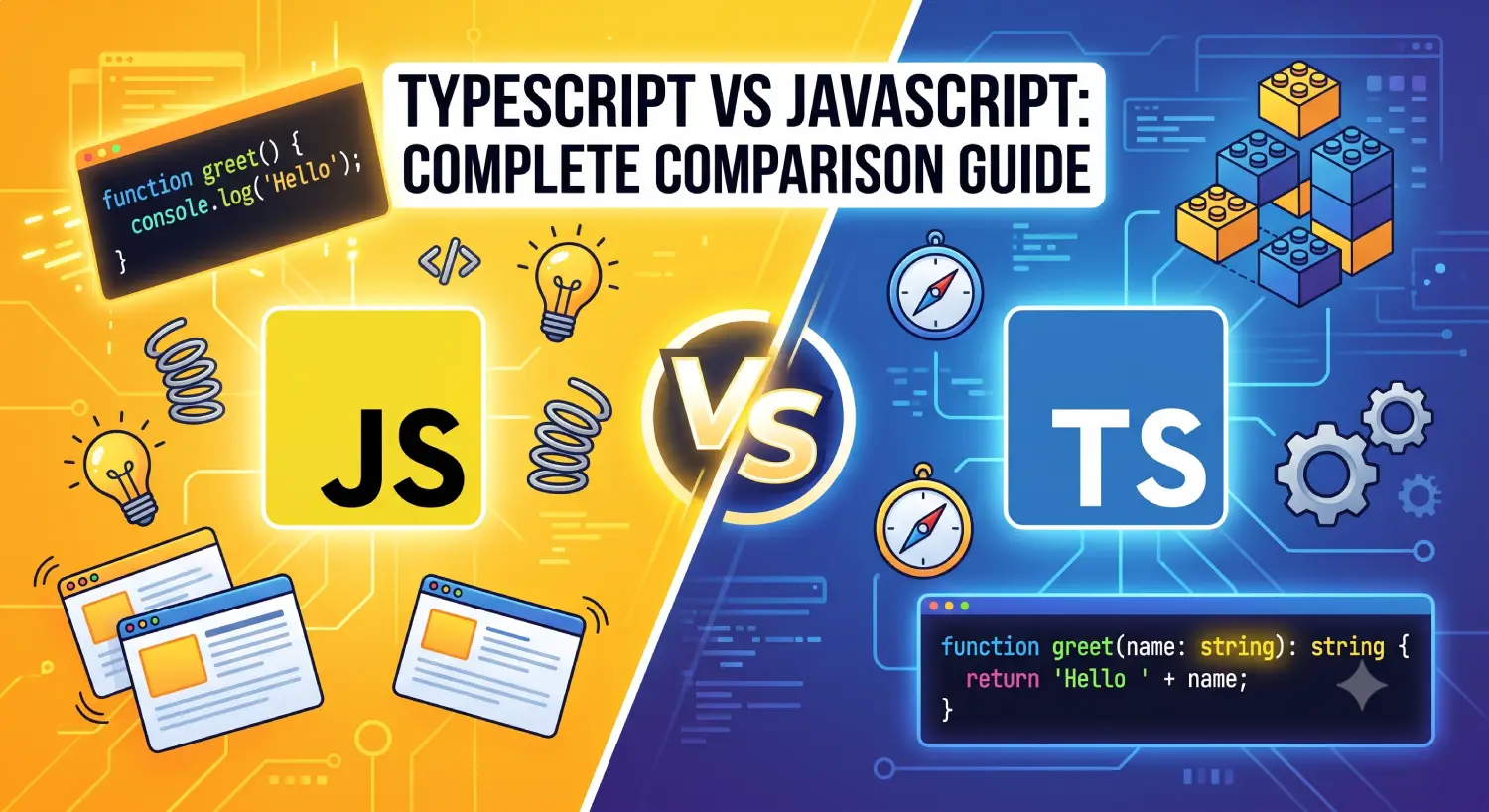
TypeScript vs JavaScript explained with practical examples. Learn how TypeScript differs from JavaScript, including static type, tooling, and when to use.
Table of Contents
JavaScript has been one of the most important programming languages for modern web development for decades. It started primarily as a browser scripting language and has evolved into a general-purpose language used for frontend applications, backend services, mobile applications, desktop software, serverless applications, and more.
TypeScript has become an important part of this ecosystem. Developed by Microsoft, TypeScript builds on JavaScript by adding a static type system and additional developer tooling. TypeScript code is ultimately transformed into JavaScript, which can then run in environments that support JavaScript.
This leads to a common question among developers:
TypeScript vs JavaScript: which one should you use?
The answer depends on the project, team, existing codebase, web development workflow, and requirements. JavaScript remains the fundamental language of the web, while TypeScript provides additional static analysis and tooling that can make larger applications easier to develop and maintain.
This guide explains the differences between TypeScript and JavaScript, including syntax, types, compilation, tooling, error detection, performance, scalability, project complexity, learning curve, frameworks, backend web development, and migration.
What Is JavaScript?
JavaScript is a dynamic, multi-paradigm programming language used extensively for web development.
It was originally designed to add interactivity to webpages, but its role has expanded considerably. Modern JavaScript is used in browsers as well as environments such as Node.js and other JavaScript runtimes.
The JavaScript language itself is standardized as ECMAScript. The current ECMAScript 2026 specification defines the language and its syntax, semantics, built-in objects, modules, and other language behavior.
JavaScript can be used for:
- Frontend web applications
- Backend APIs
- Server-side applications
- Serverless applications
- Browser extensions
- Desktop applications
- Mobile applications
- Automation
- Command-line tools
- Interactive websites
A simple JavaScript program looks like this:
const name = "Umang";

console.log(`Hello ${name}`);
JavaScript does not require you to explicitly declare the type of name.
You can also write:
let value = 10;

value = "Hello";
JavaScript allows this because variables are dynamically typed.
The actual value stored in the variable determines its runtime type.
MDN describes JavaScript as a dynamic language supporting multiple programming paradigms, including object-oriented, imperative, and functional programming.
What Is TypeScript?
TypeScript is a programming language built on top of JavaScript.
The official TypeScript documentation describes TypeScript as JavaScript with syntax for types. It adds a type system and tooling while retaining JavaScript’s runtime model.
For example:
const name: string = "Umang";

console.log(`Hello ${name}`);
Here:
: string
is a TypeScript type annotation.
You can also specify function parameter and return types:
function add(a: number, b: number): number {
    return a + b;
}
The compiler can detect incorrect calls:
add(10, 20);
is valid.
But:
add("10", 20);
will produce a type-checking error.
The important point is that TypeScript’s types are primarily a web development-time feature.
The types do not become a special runtime type system in the generated JavaScript.
TypeScript vs JavaScript at a Glance
| Feature | JavaScript | TypeScript |
|---|---|---|
| Type system | Dynamic | Static analysis with optional annotations |
| Type checking | Mainly runtime | Mainly compile/type-check time |
| File extension | .js, .mjs, .cjs |
.ts, .tsx |
| Compilation required | Usually no separate TS compilation | Usually yes, or handled by a build tool |
| Browser execution | Directly supported | TypeScript source generally needs transformation |
| Interfaces | No | Yes |
| Type aliases | No | Yes |
| Generics | No static generic system | Yes |
| Type inference | Runtime behavior | Compile-time type inference |
| Static error detection | Limited | Strong |
| Learning curve | Lower initially | Higher initially |
| Large-project maintainability | Depends heavily on tooling and discipline | Strong static tooling support |
| JavaScript interoperability | Native | Excellent |
| Runtime | JavaScript runtime | JavaScript runtime |
| Performance at runtime | JavaScript runtime | Generally same runtime after type removal |
| Migration | N/A | Can be adopted incrementally |
TypeScript does not replace JavaScript’s runtime.
Instead, it adds a web development-time layer around JavaScript.
TypeScript vs JavaScript Relationship
One of the most important concepts to understand is that TypeScript vs JavaScript are not completely separate technologies.
TypeScript intentionally builds on JavaScript.
Consider this JavaScript:
function greet(name) {
    return `Hello ${name}`;
}
The same code can be used in TypeScript:
function greet(name) {
    return `Hello ${name}`;
}
TypeScript can infer types from the code.
You can then make the types explicit:
function greet(name: string): string {
    return `Hello ${name}`;
}
This relationship is one of TypeScript’s biggest strengths.
The official TypeScript documentation explains that existing JavaScript knowledge transfers directly because TypeScript uses JavaScript’s runtime behavior.
Main Difference Between TypeScript and JavaScript
The biggest difference is static type checking.
JavaScript generally discovers type-related problems while code executes.
For example:
function calculateTotal(price, quantity) {
    return price * quantity;
}

console.log(calculateTotal("100", 2));
JavaScript’s type coercion rules may allow operations that developers did not intend.
With TypeScript:
function calculateTotal(
    price: number,
    quantity: number
): number {
    return price * quantity;
}
Now:
calculateTotal("100", 2);
produces a type error before the application is executed.
This is particularly useful as applications become larger.
Static Typing vs Dynamic Typing
JavaScript: Dynamic Typing
JavaScript variables do not require explicit type declarations.
let value = 10;
value = "Hello";
value = true;
The variable can refer to values of different types during execution.
This flexibility can be useful.
However, it can also make large codebases harder to understand because developers must often determine the expected type by reading the surrounding code.
TypeScript: Static Type Checking
TypeScript allows you to specify expected types:
let age: number = 30;

let username: string = "Umang";

let active: boolean = true;
The following would be rejected:
age = "thirty";
TypeScript can also infer types:
let age = 30;
TypeScript understands:
age: number
Therefore, you do not need to add type annotations everywhere.
The official documentation emphasizes that TypeScript understands JavaScript and uses inference to provide types automatically in many situations.
TypeScript vs JavaScript Syntax
TypeScript’s syntax is intentionally similar to JavaScript.
JavaScript:
function multiply(a, b) {
    return a * b;
}
TypeScript:
function multiply(a: number, b: number): number {
    return a * b;
}
The main additions are:
a: number
b: number
): number
These describe the expected types.
The generated JavaScript does not need these annotations.
Variables and Type Annotations
JavaScript:
let username = "Umang";
let age = 30;
let isDeveloper = true;
TypeScript:
let username: string = "Umang";
let age: number = 30;
let isDeveloper: boolean = true;
TypeScript supports many useful types, including:
string
number
boolean
bigint
symbol
object
unknown
never
void
null
undefined
It also supports more advanced constructs such as:
type
interface
enum
tuple
union
intersection
generic
Functions
Functions are one of the areas where TypeScript provides significant benefits.
JavaScript:
function getUser(id) {
    return {
        id: id,
        name: "John"
    };
}
TypeScript:
interface User {
    id: number;
    name: string;
}

function getUser(id: number): User {
    return {
        id,
        name: "John"
    };
}
Now developers can immediately understand:
- What argument the function expects
- What the function returns
- What properties the returned object contains
This becomes increasingly valuable when working with APIs and large codebases.
Objects and Interfaces
JavaScript does not have TypeScript-style interfaces.
You can create objects freely:
const user = {
    id: 1,
    name: "John",
    email: "john@example.com"
};
TypeScript allows you to describe the structure:
interface User {
    id: number;
    name: string;
    email: string;
}

const user: User = {
    id: 1,
    name: "John",
    email: "john@example.com"
};
Now TypeScript knows what a User should contain.
If you accidentally write:
const user: User = {
    id: "1",
    name: "John",
    email: "john@example.com"
};
TypeScript reports an error because id should be a number.
Structural Typing in TypeScript
An important difference between TypeScript and languages such as Java or C# is that TypeScript uses structural typing.
For example:
interface User {
    name: string;
}

const employee = {
    name: "John"
};

const user: User = employee;
This works because the structure matches.
TypeScript’s official documentation explains that structural compatibility is based on the members of the types rather than explicit nominal relationships.
This model works particularly well with JavaScript because JavaScript frequently uses objects created without explicit class hierarchies.
Type Inference
One of TypeScript’s most useful features is type inference.
You don’t always need to specify types manually.
let username = "Umang";
TypeScript infers:
username: string
Similarly:
let age = 30;
is inferred as:
age: number
For arrays:
const numbers = [10, 20, 30];
TypeScript can infer:
number[]
This means good TypeScript code does not necessarily contain type annotations on every line.
Union Types
TypeScript allows a variable to contain more than one defined type.
For example:
let id: number | string;
Now both are valid:
id = 100;
id = "100";
But:
id = true;
is invalid.
Union types are especially useful when dealing with APIs and data that can legitimately have multiple representations.
Example:
function printId(id: number | string) {
    console.log(id);
}
Type Narrowing
After defining a union type, TypeScript can analyze your JavaScript control flow and narrow the type.
For example:
function printId(id: number | string) {
    if (typeof id === "number") {
        console.log(id.toFixed(2));
    } else {
        console.log(id.toUpperCase());
    }
}
Inside the first branch, TypeScript knows that id is a number.
Inside the second branch, TypeScript knows that id is a string.
This process is called narrowing.
The official TypeScript documentation describes narrowing as the process of refining a value from a broader type to a more specific type using runtime checks such as typeof, in, and instanceof.
Error Detection
This is one of the biggest practical differences.
Consider JavaScript:
function sendEmail(user) {
    console.log(user.email);
}

sendEmail({
    name: "John"
});
The problem may only become obvious when the code runs.
In TypeScript:
interface User {
    name: string;
    email: string;
}

function sendEmail(user: User) {
    console.log(user.email);
}

sendEmail({
    name: "John"
});
The TypeScript checker can immediately identify that email is missing.
This can save debugging time.
Compilation and Execution
JavaScript can generally be executed directly by a JavaScript runtime.
For example:
console.log("Hello");
TypeScript generally goes through a TypeScript-aware toolchain before being executed as JavaScript.
For example:
const message: string = "Hello";

console.log(message);
The type annotation is not part of JavaScript runtime behavior.
The TypeScript toolchain can produce JavaScript that looks conceptually like:
const message = "Hello";

console.log(message);
The TypeScript documentation explicitly describes TypeScript as building on JavaScript and producing JavaScript that can run wherever JavaScript runs.
TypeScript 7.0 and the Native Toolchain
The current TypeScript landscape in 2026 is particularly important because TypeScript 7.0 was released on July 8, 2026.
TypeScript 7.0 represents a major architectural change.
The TypeScript team ported the compiler and associated tooling to native code using Go.
According to the official TypeScript 7.0 announcement, typical full-build speedups are approximately 8× to 12×, with the release described as a 10× faster native port overall.
This is important for large projects because TypeScript compilation and type checking can become significant parts of web development workflows.
TypeScript 7.0 also includes changes to JavaScript support, making analysis more consistent with TypeScript files.
Therefore, when writing a 2026 article, it is more accurate to discuss TypeScript 7.0 rather than treating TypeScript 5.x as the current major release.
Browser Support
JavaScript is directly supported by modern web browsers.
A browser can execute JavaScript:
<script>
    console.log("Hello");
</script>
Browsers do not generally execute TypeScript source code directly.
For example:
const message: string = "Hello";
must normally be transformed into JavaScript before deployment.
This distinction is important:
JavaScript is a runtime language.
TypeScript is a language and web development toolchain built around JavaScript with static type checking.
Runtime Performance
A common misconception is that TypeScript applications are automatically faster than JavaScript applications.
That is not generally true.
TypeScript’s type annotations primarily exist for development-time checking and are removed from emitted JavaScript.
For example:
function add(a: number, b: number): number {
    return a + b;
}
does not introduce a special TypeScript runtime.
The resulting JavaScript remains ordinary JavaScript.
Therefore, the runtime performance depends primarily on the resulting JavaScript, JavaScript engine, application architecture, algorithms, network operations, database operations, and other runtime factors.
TypeScript’s major performance benefits are often experienced during web development and tooling, rather than because the resulting JavaScript has a special runtime advantage.
Development Performance
This needs to be separated from runtime performance.
TypeScript can improve developer productivity by providing:
- Autocomplete
- Type checking
- Refactoring support
- Navigation
- Better API discovery
- Error highlighting
- Safer renaming
- Better documentation inside editors
The TypeScript compiler and language service power many of these capabilities.
TypeScript 7.0 also significantly improves compiler/tooling performance through its native implementation.
For large projects, faster type checking and builds can have a noticeable impact on development workflows.
Tooling and Developer Experience
TypeScript has strong integration with modern editors and development tools.
For example, editors can provide:
Autocomplete
Go to Definition
Find References
Rename Symbol
Inline Type Information
Error Diagnostics
Refactoring
Consider:
interface Product {
    id: number;
    name: string;
    price: number;
}
When typing:
product.
your editor can understand available properties.
JavaScript can also provide excellent tooling, especially with modern language servers, inference, and JSDoc.
However, TypeScript gives tools more explicit type information to work with.
TypeScript vs JavaScript for Large Projects
For a large application, the number of developers, files, modules, APIs, and dependencies can grow significantly.
For example:
src/
├── components/
├── services/
├── controllers/
├── models/
├── hooks/
├── utils/
├── repositories/
└── types/
A function may be called by dozens of files.
Without explicit contracts, changing a function can become risky.
TypeScript allows you to define contracts:
interface PaymentService {
    processPayment(amount: number): Promise<boolean>;
}
Now consumers know what the service expects.
This becomes especially useful in:
- Enterprise applications
- SaaS platforms
- Large React applications
- Backend APIs
- Multi-developer teams
- Shared libraries
- Long-lived applications
TypeScript vs JavaScript for Small Projects
JavaScript can be extremely convenient for smaller projects.
For example, if you are building:
- A small script
- A simple website
- A quick prototype
- A browser experiment
- A small automation script
adding a complete TypeScript toolchain may not always be necessary.
JavaScript allows you to start immediately:
console.log("Hello World");
There is less configuration and fewer concepts to learn initially.
However, TypeScript can still be useful for small projects when you want stronger editor assistance.
TypeScript with React
TypeScript is widely used with React applications.
A React component can be written in JavaScript:
function UserCard({ user }) {
    return <h2>{user.name}</h2>;
}
With TypeScript:
interface User {
    name: string;
    email: string;
}

interface UserCardProps {
    user: User;
}

function UserCard({ user }: UserCardProps) {
    return <h2>{user.name}</h2>;
}
Now the component’s expected data structure is documented directly in the code.
TypeScript files containing JSX generally use the .tsx extension.
This is particularly useful when React applications become larger.
TypeScript with Node.js
JavaScript can be used directly for Node.js applications:
const http = require("http");
TypeScript can also be used for backend development.
For example:
interface User {
    id: number;
    name: string;
}

function getUser(id: number): User {
    return {
        id,
        name: "John"
    };
}
TypeScript can be particularly helpful for backend applications because APIs, database models, services, request objects, and responses can all have defined structures.
TypeScript with APIs
Consider an API response:
{
    "id": 1,
    "name": "John",
    "email": "john@example.com"
}
JavaScript:
fetch("/api/user")
    .then(response => response.json())
    .then(user => {
        console.log(user.name);
    });
TypeScript can describe the expected structure:
interface User {
    id: number;
    name: string;
    email: string;
}
You can then use that type throughout your application.
However, an important point is that TypeScript types do not automatically validate external runtime data.
If an API sends malformed data, your TypeScript interface alone does not magically validate the JSON.
For untrusted external data, runtime validation may still be required.
This distinction is critical:
TypeScript provides static guarantees about your code.
Runtime validation checks actual runtime data.
TypeScript vs JavaScript Modules
Modern JavaScript supports modules.
JavaScript:
export function add(a, b) {
    return a + b;
}
TypeScript:
export function add(a: number, b: number): number {
    return a + b;
}
The module system remains conceptually the same.
TypeScript adds type information around the JavaScript module system.
The ECMAScript specification defines JavaScript scripts and modules as part of the language specification.
TypeScript Configuration
A TypeScript project commonly uses:
tsconfig.json
This file controls compiler and type-checking behavior.
For example:
{
    "compilerOptions": {
        "target": "ES2022",
        "module": "ESNext",
        "strict": true
    }
}
The official TypeScript TSConfig reference documents the available compiler options.
A project’s configuration can control:
- JavaScript target
- Module system
- Strictness
- Source maps
- Declaration files
- JSX handling
- Module resolution
- Type checking
- Output directories
TypeScript strict Mode
For many TypeScript projects, strict is an important setting.
{
    "compilerOptions": {
        "strict": true
    }
}
The official documentation states that strict enables a broad family of type-checking behaviors that provide stronger correctness guarantees.
For example, strictNullChecks helps distinguish between values that can be null or undefined and values that are guaranteed to exist.
Consider:
const user = users.find(
    user => user.name === username
);

console.log(user.age);
With strict null checking enabled, TypeScript recognizes that .find() may not return a user.
You must handle the possibility:
if (user) {
    console.log(user.age);
}
This encourages developers to deal with possible runtime cases during development.
Can JavaScript Code Be Used in TypeScript?
Yes.
A large amount of normal JavaScript is valid TypeScript.
For example:
function greet(name) {
    return `Hello ${name}`;
}
can initially exist as TypeScript without adding explicit annotations.
You can gradually improve it:
function greet(name: string): string {
    return `Hello ${name}`;
}
This incremental approach is one reason TypeScript is practical for existing JavaScript projects.
The official TypeScript documentation includes a dedicated guide for migrating JavaScript projects to TypeScript.
JavaScript with JSDoc
You do not necessarily have to convert a JavaScript project to .ts files immediately.
TypeScript can provide type information inside JavaScript through JSDoc.
For example:
/**
 * @param {number} price
 * @param {number} quantity
 * @returns {number}
 */
function calculateTotal(price, quantity) {
    return price * quantity;
}
This allows TypeScript-powered tooling to understand more about the JavaScript code.
You can also use:
// @ts-check
to enable stronger checking in a JavaScript file.
The TypeScript documentation describes multiple levels of type checking for JavaScript projects, ranging from inference and JSDoc to // @ts-check and full TypeScript with strict enabled.
Can TypeScript Replace JavaScript?
Not in the sense of eliminating JavaScript.
TypeScript ultimately targets JavaScript environments.
The relationship can be understood as:
TypeScript
    ↓
Type checking + transformation
    ↓
JavaScript
    ↓
JavaScript runtime
    ↓
Browser / Node.js / other runtime
TypeScript therefore complements JavaScript rather than creating a separate runtime ecosystem.
The TypeScript documentation explicitly emphasizes that TypeScript code becomes JavaScript and can run wherever JavaScript runs.
Migrating JavaScript to TypeScript
A JavaScript project can be migrated gradually.
A practical approach is:
Step 1: Identify the project
Start with:
JavaScript project
Do not immediately rewrite everything.
Step 2: Add TypeScript tooling
Install TypeScript according to the current project setup.
Then create a configuration:
tsconfig.json
Step 3: Start with simple files
Rename selected files:
user.js
to:
user.ts
Step 4: Add types gradually
Start with important boundaries:
interface User {
    id: number;
    name: string;
}
Then add function types:
function getUser(id: number): User {
    // ...
}
Step 5: Enable stricter checking
Once the project has been converted sufficiently, enable:
{
    "compilerOptions": {
        "strict": true
    }
}
Step 6: Fix errors incrementally
Do not try to rewrite an entire large application in one step.
Prioritize:
- Public APIs
- Shared utilities
- Data models
- Services
- Core business logic
- UI components
The official TypeScript migration guide recommends an incremental approach because JavaScript and TypeScript are designed to work within the same ecosystem.
Advantages of JavaScript
1. Simple to Start
JavaScript requires relatively little setup for basic applications.
console.log("Hello World");
2. Direct Browser Support
Browsers execute JavaScript directly.
3. Huge Ecosystem
JavaScript has an enormous ecosystem of frameworks, libraries, tools, packages, and learning resources.
4. Flexible
Dynamic typing can be convenient for prototypes and smaller scripts.
5. Fast Development for Small Tasks
For simple scripts, adding a type system may be unnecessary overhead.
Advantages of TypeScript
1. Static Type Checking
Type errors can often be discovered before runtime.
2. Better Editor Support
Types provide editors with additional information for:
- Autocomplete
- Navigation
- Refactoring
- Documentation
3. Better Maintainability
Types can document relationships between parts of an application.
4. Safer Refactoring
Changing a function signature can reveal affected code.
5. Better Large-Team Collaboration
Types provide explicit contracts between developers and modules.
6. Excellent JavaScript Compatibility
Existing JavaScript knowledge remains useful.
7. Gradual Adoption
You can introduce TypeScript incrementally rather than converting everything immediately.
8. Improved TypeScript 7.0 Tooling Performance
The native TypeScript 7.0 toolchain provides major compiler and tooling performance improvements, with the TypeScript team reporting typical 8×–12× speedups on full builds.
Disadvantages of JavaScript
1. Runtime Type Problems
Some mistakes are discovered only when code executes.
2. Less Explicit Contracts
Large JavaScript projects can require additional documentation and conventions.
3. Refactoring Can Become Riskier
Without strong type information, tools may have less information about how values are used.
4. Large Codebases Require Strong Discipline
JavaScript can absolutely be used successfully at scale, but teams often need strong conventions, tests, documentation, linting, and tooling.
Disadvantages of TypeScript
1. Additional Learning
Developers need to understand:
- Types
- Interfaces
- Generics
- Unions
- Intersections
- Narrowing
- Type inference
- Compiler configuration
2. Additional Tooling
TypeScript projects typically require a type-checking/transformation step.
3. Type Complexity
Poorly designed types can become difficult to understand.
For example, highly complex generic types may be harder to maintain than straightforward code.
4. Types Do Not Validate Runtime Data Automatically
This is an important limitation.
Suppose you define:
interface User {
    id: number;
    name: string;
}
An external API could still return:
{
    "id": "wrong",
    "name": 123
}
The TypeScript interface does not automatically inspect and validate the network response.
Runtime validation is a separate concern.
TypeScript vs JavaScript: Pros and Cons
| Area | JavaScript | TypeScript |
|---|---|---|
| Getting started | Very easy | Moderate |
| Type safety | Dynamic | Static checking |
| Flexibility | Very high | High |
| Editor support | Excellent | Excellent |
| Large applications | Requires discipline | Strong type tooling |
| Small scripts | Excellent | Sometimes unnecessary |
| Refactoring | Good | Usually stronger |
| Configuration | Lower | Higher |
| Browser execution | Direct | Usually transformed first |
| Runtime | JavaScript | JavaScript |
| Learning curve | Lower | Higher |
| Migration | N/A | Incremental |
Common TypeScript vs JavaScript Misconceptions
Myth 1: TypeScript Is a Completely Different Runtime
It is not.
TypeScript targets JavaScript.
Myth 2: TypeScript Is Always Faster
Not necessarily.
TypeScript’s primary benefits are static checking and tooling.
The generated application still runs using a JavaScript runtime.
Myth 3: TypeScript Eliminates Runtime Errors
No.
TypeScript can catch many classes of mistakes, particularly type-related problems, before execution.
But runtime problems can still occur.
For example:
- Network failures
- Invalid external data
- Database errors
- Authentication failures
- File system failures
- Logic bugs
- Race conditions
Myth 4: Every Variable Needs a Type
No.
Type inference handles many situations:
const username = "Umang";
TypeScript can infer:
string
Myth 5: JavaScript Is Not Suitable for Large Applications
This is also incorrect.
Large applications can be built with JavaScript.
TypeScript provides additional static analysis and tooling that many teams find useful for managing complexity.
Which Should Beginners Learn?
For someone completely new to programming, JavaScript is an important foundation.
Understanding JavaScript helps you understand:
- Variables
- Functions
- Objects
- Arrays
- Scope
- Closures
- Promises
- Async/await
- Modules
- Classes
- Prototypes
- The event loop
- Browser APIs
TypeScript does not replace the need to understand JavaScript runtime behavior.
The official TypeScript documentation itself recommends learning JavaScript fundamentals for developers who are completely new to programming.
A practical learning path is:
HTML
  ↓
CSS
  ↓
JavaScript
  ↓
Modern JavaScript
  ↓
TypeScript
  ↓
React / Angular / Vue / Node.js
Which Should Professional Developers Use?
There is no universal requirement that every project must use TypeScript.
The choice should consider the project.
JavaScript can be appropriate when:
- The project is small.
- Rapid prototyping is important.
- The team prefers JavaScript.
- The codebase already works well.
- The additional type system does not provide enough benefit.
TypeScript can be useful when:
- The project is large.
- Multiple developers work on the same codebase.
- The application has many APIs.
- Refactoring is frequent.
- Long-term maintenance matters.
- Complex data structures are involved.
- Strong editor tooling is valuable.
The TypeScript documentation itself describes TypeScript as a static type checker for JavaScript programs and emphasizes its usefulness as JavaScript applications grow in complexity.
TypeScript vs JavaScript: When to Use Each
Choose JavaScript When
Small project
      ↓
Simple requirements
      ↓
Minimal configuration
      ↓
JavaScript
Examples:
- Small website
- Simple automation
- Quick prototype
- Browser script
- Learning JavaScript
Consider TypeScript When
Large application
      ↓
Multiple modules
      ↓
Multiple developers
      ↓
Complex data
      ↓
Long-term maintenance
      ↓
TypeScript
Examples:
- Enterprise web applications
- SaaS platforms
- Large React applications
- Backend APIs
- Shared libraries
- Large Node.js applications
- Complex frontend applications
TypeScript vs JavaScript for 2026
The JavaScript ecosystem continues to evolve through the ECMAScript standard.
The ECMAScript 2026 specification is the current yearly language specification and is maintained by TC39. The specification defines the standardized JavaScript language, while host environments such as browsers and Node.js provide additional runtime APIs.
At the same time, TypeScript has entered a new phase with TypeScript 7.0.
The TypeScript 7.0 release is particularly significant because the compiler and toolchain have moved to a native implementation. The TypeScript team reports substantial performance improvements while maintaining compatibility with the existing type-checking model.
This means developers evaluating TypeScript in 2026 should not rely solely on comparisons written several years ago.
The current ecosystem is different from the TypeScript 4.x or early TypeScript 5.x era.
A Simple Example: TypeScript vs JavaScript
JavaScript
function calculateDiscount(price, discount) {
    return price - (price * discount / 100);
}

console.log(calculateDiscount(1000, 10));
JavaScript is concise and straightforward.
TypeScript
function calculateDiscount(
    price: number,
    discount: number
): number {
    return price - (price * discount / 100);
}

console.log(calculateDiscount(1000, 10));
The additional information communicates:
price → number
discount → number
return value → number
If someone later writes:
calculateDiscount("1000", 10);
TypeScript can flag the incorrect argument before the program runs.
This is the fundamental value proposition of TypeScript.
Another Practical Example: API Data
Suppose an application receives user data.
JavaScript:
function displayUser(user) {
    console.log(user.name);
    console.log(user.email);
}
TypeScript:
interface User {
    id: number;
    name: string;
    email: string;
}

function displayUser(user: User): void {
    console.log(user.name);
    console.log(user.email);
}
Now the expected structure is part of the code.
This can make larger applications easier to navigate.
TypeScript Is More Than Just Type Annotations
It is tempting to think of TypeScript as:
JavaScript + types
That is true at a high level, but TypeScript provides much more.
Its type system includes:
- Type inference
- Union types
- Intersection types
- Generics
- Conditional types
- Mapped types
- Template literal types
- Type predicates
- Utility types
- Declaration files
- Structural typing
- Control-flow analysis
It also provides tooling around the language.
The official documentation includes dedicated sections covering everyday types, narrowing, functions, object types, classes, modules, utility types, declaration files, JavaScript projects, and compiler configuration.
Important TypeScript Best Practices
If you choose TypeScript, consider the following practices.
Use Inference Where It Is Clear
Instead of:
const name: string = "John";
you can often write:
const name = "John";
TypeScript already knows the type.
Prefer Specific Types
Avoid unnecessarily broad types.
For example:
function process(data: any) {
    // ...
}
reduces the benefit of TypeScript.
The official TypeScript documentation warns that any effectively disables type checking for that value and should generally not be used unless there is a specific reason, such as migration work.
Use unknown for Unknown Data
When data is genuinely unknown:
function process(data: unknown) {
    if (typeof data === "string") {
        console.log(data.toUpperCase());
    }
}
This forces you to establish what the value actually is before using it.
Consider Strict Mode
{
    "compilerOptions": {
        "strict": true
    }
}
The official TypeScript documentation recommends strict as a stronger checking configuration.
Frequently Asked Questions
Is TypeScript better than JavaScript?
TypeScript and JavaScript solve slightly different development needs.
TypeScript adds static type checking and additional tooling to JavaScript.
Whether those benefits are useful depends on the project’s size, team, complexity, and maintenance requirements.
Is TypeScript replacing JavaScript?
No.
TypeScript is built around JavaScript and produces JavaScript for execution.
JavaScript remains the standardized programming language used by browsers and many other runtimes.
Does TypeScript run directly in browsers?
Generally, TypeScript source is transformed into JavaScript before browser execution.
Browsers execute JavaScript.
Is TypeScript faster than JavaScript?
Not inherently at runtime.
TypeScript’s type annotations are primarily development-time constructs.
However, TypeScript 7.0 significantly improves the performance of the TypeScript compiler and tooling itself through its native implementation.
Is TypeScript difficult to learn?
The basics are relatively approachable if you already know JavaScript.
The more advanced type system can take considerably longer to master.
A good approach is to learn:
JavaScript
→ Type annotations
→ Interfaces
→ Unions
→ Narrowing
→ Generics
→ Utility types
→ Advanced types
Can I use TypeScript in React?
Yes.
TypeScript is commonly used with React applications, and .tsx files allow TypeScript code containing JSX.
Can I use TypeScript with Node.js?
Yes.
TypeScript can be used to develop backend applications that target Node.js and other JavaScript runtimes.
Can I convert an existing JavaScript project to TypeScript?
Yes.
TypeScript is designed to support gradual migration.
You can migrate individual files and add types progressively.
Do I need to learn JavaScript before TypeScript?
For most developers, learning JavaScript first is strongly recommended.
TypeScript does not change the underlying JavaScript runtime behavior.
The official TypeScript documentation recommends JavaScript fundamentals for developers who are new to programming.
Does TypeScript prevent all bugs?
No.
TypeScript primarily helps detect type-related problems before runtime.
It does not automatically eliminate:
- Business logic errors
- Network failures
- Database failures
- Security vulnerabilities
- Invalid external data
- Concurrency problems
- Incorrect application requirements
Testing and runtime validation remain important.
Is TypeScript strongly typed?
TypeScript provides a static type system, but describing it simply as “strongly typed” can be misleading because its type system has JavaScript compatibility goals and uses structural typing.
It is better to think of TypeScript as a statically analyzed language with a structural type system.
What is the latest TypeScript version in 2026?
As of September 19, 2026, the current major release is TypeScript 7.0, released on July 8, 2026.
TypeScript 7.0 is the native implementation of the TypeScript toolchain and brings major compiler performance improvements.
TypeScript vs JavaScript: Final Comparison
The simplest way to understand the relationship is:
JavaScript
    │
    │ Runtime language
    │
    ▼
JavaScript Runtime
while:
TypeScript
    │
    ├── Static type checking
    ├── Type inference
    ├── Developer tooling
    ├── Interfaces
    ├── Generics
    └── Additional type-system features
            │
            ▼
       JavaScript
            │
            ▼
    JavaScript Runtime
JavaScript provides the runtime foundation.
TypeScript builds additional development-time capabilities on top of that foundation.
For beginners, learning JavaScript remains important because TypeScript does not replace knowledge of JavaScript’s runtime behavior.
For large and complex applications, TypeScript can provide valuable tooling and static guarantees that make code easier to understand, refactor, and maintain.
The best approach is therefore not to think of TypeScript as a competitor that eliminates JavaScript.
Instead:
JavaScript is the foundation, while TypeScript is a development layer that helps JavaScript applications scale.
References
For continued learning, use the official documentation as the primary reference:
- TypeScript Documentation
- TypeScript 7.0 Announcement
- ECMAScript 2026 Specification
- MDN JavaScript Guide
Conclusion
The TypeScript vs JavaScript discussion is not simply about choosing one programming language over another.
JavaScript is the standardized language underlying the modern web and is used across browsers, servers, desktop applications, mobile applications, and many other environments. The ECMAScript 2026 specification continues to define the standardized JavaScript language.
TypeScript extends JavaScript with a static type system and powerful developer tooling. It can detect many type-related problems before an application runs, improve autocomplete and navigation, provide clearer contracts between modules, and make large codebases easier to maintain.
The 2026 TypeScript ecosystem is also significant because TypeScript 7.0 introduced a native implementation with major compiler and tooling performance improvements.
For beginners, a strong learning path is:
JavaScript fundamentals
        ↓
Modern JavaScript
        ↓
TypeScript fundamentals
        ↓
Advanced TypeScript
        ↓
React / Node.js / Angular / Vue
For small scripts and simple projects, JavaScript can remain an excellent choice.
For large applications, teams, shared libraries, and long-lived codebases, TypeScript’s static analysis and tooling can provide substantial development benefits.
Ultimately, the most important skill is not simply knowing whether to use .js or .ts.
It is understanding JavaScript deeply and knowing when TypeScript’s additional type system and tooling provide value.