In this article, we’ll see the FastAPI Overview.
Table of Contents
In modern web development, building high-performance APIs quickly and efficiently is essential. Python developers now have access to powerful frameworks that simplify backend development while maintaining speed and scalability. One such framework that has gained massive popularity is FastAPI.
In this article, we will explore FastAPI in 2026, including its features, benefits, installation, architecture, advantages, disadvantages, and real-world use cases. Whether you’re a beginner or an experienced developer, this guide will help you understand why FastAPI is one of the most preferred frameworks for API development today.
What is FastAPI?
It is a web framework for developing RESTful APIs with Python 3.6+ based on standard Python type-hints that is current and quick (high-performance).
RESTful APIs enable you to develop the back end separately from the front end and still have them work harmoniously together even if separately hosted.
FastAPI was Created by developer Sebastián Ramírez and initially released on December 8, 2018, and stable release on January 23, 2022.
The primary focus of it is, in
- Fast development
- Fewer bugs
- High and fast performance.
Companies like Netflix and Uber are using this framework which fully supports asynchronous programming and can run with WSGI(Web Server Gateway Interface) and ASGI(Asynchronous Server Gateway Interface).
Why Use FastAPI in 2026?
Fast API stands out because it combines:
- High performance (comparable to Node.js and Go)
- Rapid development speed
- Automatic validation using Python type hints
- Built-in API documentation
- Full async support (ASGI)
Companies like Netflix, Uber, and other tech-driven organizations use Fast API for building scalable backend services.
Key Features of FastAPI
1. High Performance
FastAPI is built on top of Starlette (for web handling) and Pydantic (for data validation), making it one of the fastest Python frameworks available.
2. Type Hint-Based Development
Using Python type hints ensures:
- Automatic request validation
- Better IDE support
- Cleaner and more maintainable code
3. Automatic API Documentation
Fast API automatically generates:
- Swagger UI (
/docs) - ReDoc (
/redoc)
This reduces manual documentation effort.
4. Asynchronous Support
Fast API fully supports async/await, enabling high concurrency and efficient performance.
5. Data Validation with Pydantic
Fast API ensures strict validation for request and response data, reducing runtime errors.
Benefits:
The followings are some of the benefits:
- Fast: Very high performance, on par with NodeJS and Go (thanks to Starlette and Pydantic). One of the fastest Python frameworks available.
- Fast to code: Increase the speed to develop features by about 200% to 300%. *
- Fewer bugs: Reduce about 40% of human (developer) induced errors. *
- Intuitive: Great editor support. Completion everywhere. Less time debugging.
- Easy: Designed to be easy to use and learn. Less time reading docs.
- Short: Minimize code duplication. Multiple features from each parameter declaration. Fewer bugs.
- Robust: Get production-ready code. With automatic interactive documentation.
Installation:
Before proceeding with installation, you should have python 3.6+ preinstalled. Follow below steps:
step 1. Run “pip install fastapi” command in terminal
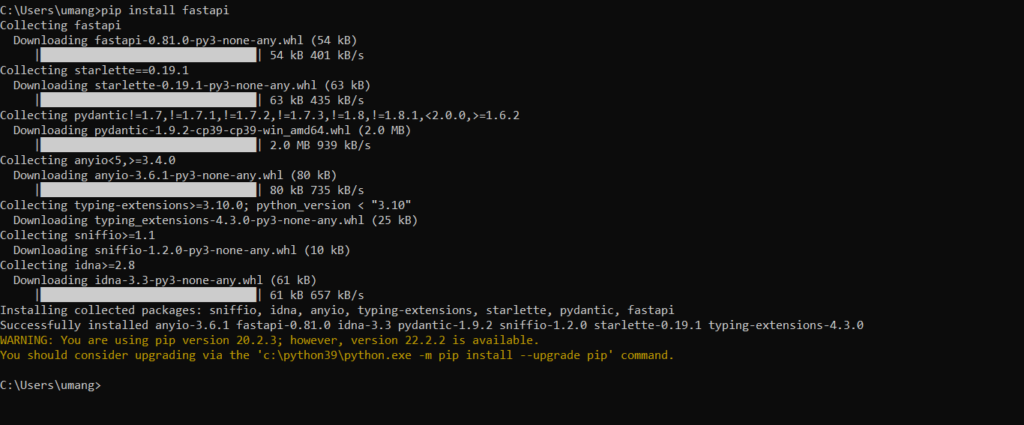
step 2: Once fastapi is installed as per the above step, we need to set up “uvicorn” as a server. so, run “pip install “uvicorn[standard]” –user” command in terminal
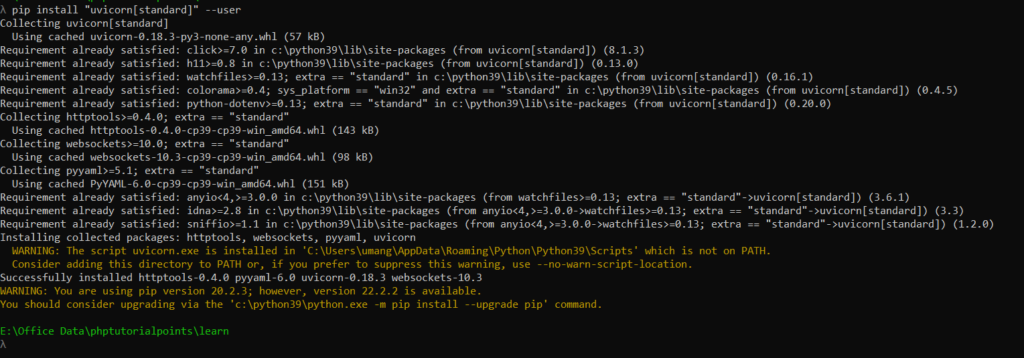
step 3: now, uvicorn and fastapi is installed successfully. Let’s create a “main.py” file with the following code and save it
from typing import Union

from fastapi import FastAPI

app = FastAPI()

@app.get("/")
def read_root():
    return {"Hello": "World"}

@app.get("/items/{item_id}")
def read_item(item_id: int, q: Union[str, None] = None):
    return {"item_id": item_id, "q": q}
Step 4: Open a terminal and go to the path where the above file was created. after then, run the “python -m uvicorn main:app –reload” command in your terminal. your application is now running. Now, open “http://127.0.0.1:8000/items/5?q=somequery.” URL in your browser and you will see the following output:
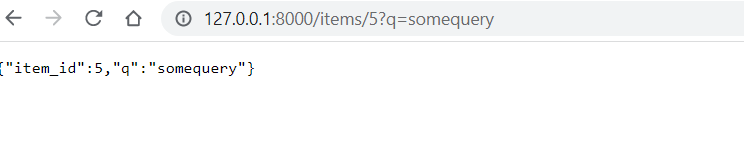
You already created an API that:
- Receives HTTP requests in the paths
/and/items/{item_id}. - Both paths take
GEToperations (also known as HTTP methods). - The path
/items/{item_id}has a path parameteritem_idthat should be anint. - The path
/items/{item_id}has an optionalstrquery parameterq.
Your application is ready.
Now go to http://127.0.0.1:8000/docs. You will see the automatic interactive API documentation (provided by Swagger UI)
And now, go to http://127.0.0.1:8000/redoc. You will see the alternative automatic documentation (provided by ReDoc)
You can follow below for video for installation process if you need:
FastAPI Architecture Overview
FastAPI is built using modern Python technologies:
- ASGI (Asynchronous Server Gateway Interface)
- Starlette – Web framework layer
- Pydantic – Data validation layer
Architecture Flow:
Client Request → FastAPI → Pydantic Validation → Business Logic → Response → Documentation
Use Cases of Fast API
Fast API is widely used for:
- RESTful API development
- Microservices architecture
- Machine learning model APIs
- Real-time applications
- Data processing services
- Backend for web & mobile apps
Advantages and Disadvantages:
Advantages:
- It helps in validating the datatype from the developer even in nested JSON requests.
- It gives the autocomplete feature which helps in producing applications with less amount of effort and also less time in debugging.
- It is based on and also compatible with the OpenAPI.
- It makes it easy to build a GraphQL API with a Python library called graphene-python.
- It integrates well with OAuth 2.0 and external providers.
Disadvantages:
- It is a relatively new framework so the guideline community is small. We have lower external educational information like books, courses, or tutorials.
- Since in the development of the applications we need to tie everything together in the FastAPI application which causes the main file to become very long or crowded.
FastAPI vs Other Frameworks
| Feature | FastAPI | Django | Flask |
|---|---|---|---|
| Performance | ⭐⭐⭐⭐⭐ | ⭐⭐⭐ | ⭐⭐⭐ |
| Ease of Use | ⭐⭐⭐⭐ | ⭐⭐⭐⭐ | ⭐⭐⭐⭐⭐ |
| Async Support | Yes | Limited | No |
| Documentation | Auto | Manual | Manual |
| Learning Curve | Medium | Medium | Easy |
Best Practices for Fast API in 2026
- Use Python 3.10+ for better performance
- Structure projects using routers and modules
- Use Pydantic models for request/response validation
- Implement dependency injection
- Use environment variables for configuration
- Add authentication using OAuth2/JWT
References
- Official Documentation: https://fastapi.tiangolo.com/
- GitHub Repository: https://github.com/tiangolo/fastapi
- Comparison Guide: https://analyticsindiamag.com/django-vs-flask-vs-fastapi-a-comparative-guide-to-python-web-frameworks/
Conclusion
Fast API has become one of the most powerful and efficient frameworks for building APIs in Python. With its combination of speed, simplicity, and modern features like async support and automatic documentation, it is an excellent choice for developers in 2026.
Whether you’re building small APIs or large-scale microservices, Fast API provides the tools and performance needed to succeed in today’s fast-paced development environment.
Hope this article helps!