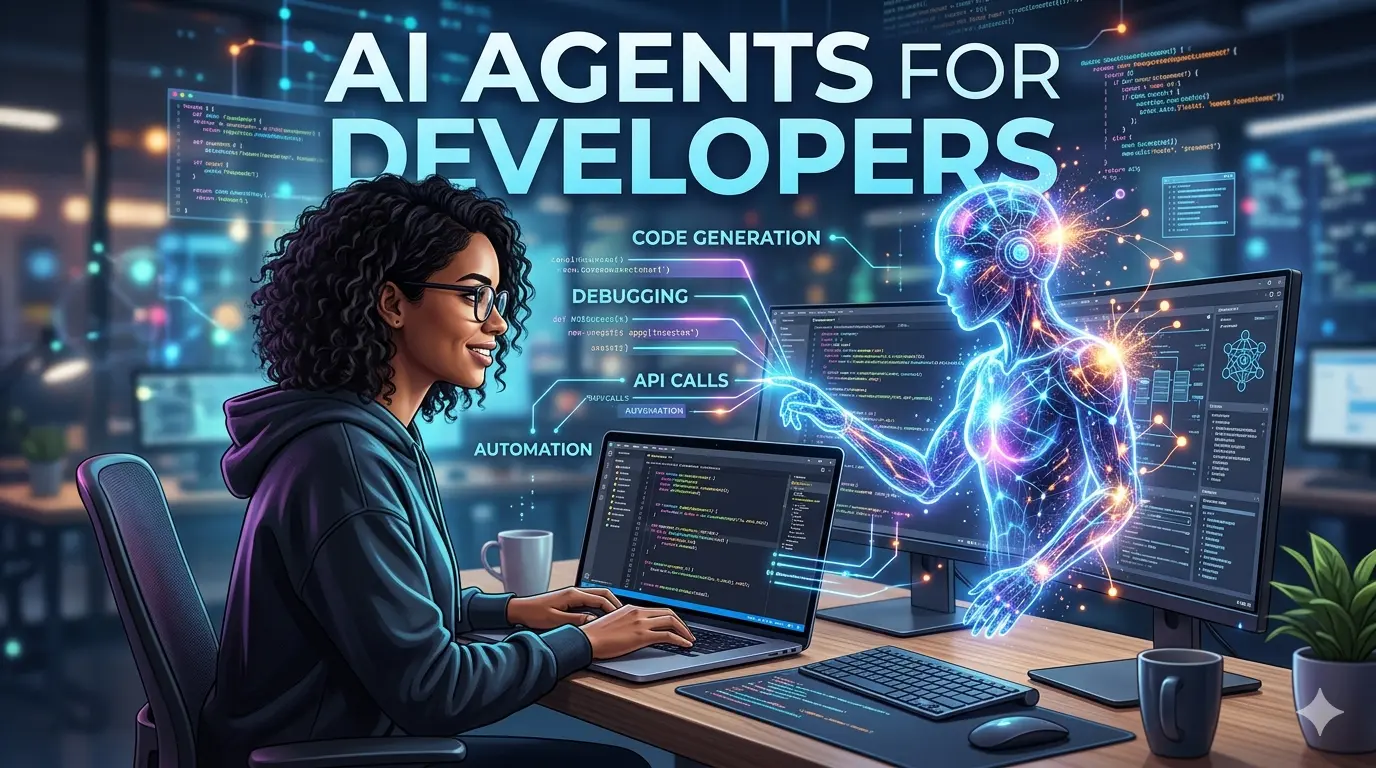
Artificial Intelligence is no longer limited to chatbots and code suggestions. In 2026, AI agents are transforming the way developers build applications, automate workflows, debug systems, manage infrastructure, and even collaborate with teams. These intelligent systems are rapidly becoming a core part of modern software engineering.
Table of Contents
From autonomous coding assistants to multi-agent workflows capable of planning, reasoning, executing, and monitoring tasks, AI agents are shaping the future of automation across industries. Developers are now integrating agentic AI into SaaS products, DevOps pipelines, customer support systems, cybersecurity tools, and enterprise applications.
Major technology companies and open-source communities are heavily investing in agent-based architectures, frameworks, and protocols. Standards like the Model Context Protocol (MCP) are helping AI systems interact with external tools, APIs, databases, and services in a more structured and interoperable way. (Claude API Docs)
In this detailed 2026 guide, you will learn:
- What AI agents are
- How AI agents work
- Types of AI agents for developers
- Real-world use cases
- AI agent architecture
- Popular frameworks and tools
- Multi-agent systems
- AI agent security concerns
- Benefits and limitations
- Future trends in agentic AI
- Best practices for developers
- Career opportunities in AI automation
What Are AI Agents?
AI agents are intelligent software systems designed to perform tasks autonomously by observing their environment, reasoning about goals, making decisions, and taking actions.
Unlike traditional automation scripts that follow fixed rules, They can:
- Understand natural language
- Adapt to changing conditions
- Use tools and APIs
- Learn from interactions
- Execute multi-step workflows
- Collaborate with other agents
- Make contextual decisions
It typically combines:
- Large Language Models (LLMs)
- Memory systems
- Planning engines
- Tool integrations
- Reasoning capabilities
- External APIs
- Workflow orchestration
Modern AI agents can behave like virtual developers, assistants, researchers, operators, or autonomous workers.
Why It Matter in 2026
The software development industry is moving toward autonomous workflows. Developers no longer want AI that only answers questions — they want systems that can complete tasks end-to-end.
Examples include:
- Generating and deploying code
- Monitoring servers
- Debugging applications
- Writing documentation
- Performing QA testing
- Managing tickets
- Conducting research
- Creating reports
- Running DevOps operations
According to recent developer surveys, multi-agent workflows are significantly increasing productivity, with developers saving several hours per week through AI-assisted automation. (Ivern AI)
Organizations are restructuring teams around AI-powered workflows and agent-based collaboration models. (The Wall Street Journal)
Evolution of AI Automation
Traditional Automation
Older automation systems relied on:
- Shell scripts
- CRON jobs
- CI/CD pipelines
- Rule-based systems
- Workflow engines
These systems worked well for repetitive tasks but lacked intelligence and adaptability.
AI-Powered Automation
Modern AI automation introduces:
- Context awareness
- Natural language understanding
- Reasoning
- Dynamic planning
- Self-correction
- API orchestration
They can now decide:
- What to do
- Which tools to use
- When to retry
- How to optimize workflows
- How to collaborate with other agents
Core Components of It
1. Large Language Models (LLMs)
LLMs act as the reasoning engine behind them.
Popular models include:
- GPT models
- Claude models
- Gemini models
- Open-source LLMs
- Specialized coding models
These models interpret instructions and generate responses or actions.
2. Memory Systems
AI agents use memory to maintain context.
Memory can include:
- Conversation history
- Task states
- User preferences
- Cached research
- Workflow progress
Memory enables long-term reasoning and continuity.
3. Planning Engine
The planning system breaks large goals into smaller tasks.
Example:
Goal:
“Deploy a Laravel application”
Subtasks:
- Clone repository
- Install dependencies
- Configure environment
- Run migrations
- Deploy to server
- Verify deployment
4. Tool Usage
AI agents become powerful when connected to tools.
Examples:
- GitHub APIs
- Docker
- Kubernetes
- Databases
- Web browsers
- File systems
- Terminal commands
- Cloud providers
5. Execution Layer
This component performs real-world actions such as:
- Running code
- Calling APIs
- Deploying applications
- Sending emails
- Updating tickets
Types of AI Agents
Reactive Agents
These agents respond to inputs without memory.
Example:
A chatbot answering user queries.
Goal-Based Agents
These agents work toward objectives.
Example:
An AI deployment assistant.
Learning Agents
These systems improve using feedback and experience.
Example:
Recommendation systems.
Multi-Agent Systems
Multiple agents collaborate together.
Example:
- Research agent
- Coding agent
- Testing agent
- Deployment agent
Autonomous Coding Agents
These agents can:
- Write code
- Refactor applications
- Fix bugs
- Generate tests
- Create documentation
AI Agents for Developers
Developers are using AI agents across every stage of software development.
Code Generation
AI agents can generate:
- APIs
- UI components
- Database schemas
- Unit tests
- Documentation
Debugging
Agents analyze:
- Stack traces
- Runtime logs
- Error reports
- Performance bottlenecks
DevOps Automation
AI agents can automate:
- CI/CD pipelines
- Kubernetes operations
- Infrastructure provisioning
- Monitoring systems
- Cloud deployments
QA and Testing
AI testing agents can:
- Generate test cases
- Perform regression testing
- Detect UI changes
- Simulate user workflows
Security Automation
Security-focused agents help with:
- Vulnerability scanning
- Dependency analysis
- Threat detection
- Compliance auditing
Popular AI Agent Frameworks in 2026
OpenAI Agents SDK
The OpenAI Agents SDK provides tools for building agentic applications with:
- Tool calling
- Agent handoffs
- Tracing
- Context management
- Multi-agent workflows
Key Features
- Structured orchestration
- Workflow automation
- Tool integrations
- Scalable architecture
LangChain
LangChain remains one of the most popular frameworks for AI application development.
Features include:
- Chains
- Agents
- Memory
- Retrieval systems
- Tool integrations
AutoGen
AutoGen enables multi-agent collaboration and conversational workflows.
CrewAI
CrewAI focuses on collaborative AI agents with role-based orchestration.
Semantic Kernel
Semantic Kernel integrates AI reasoning into enterprise applications.
Model Context Protocol (MCP)
One of the biggest innovations in agentic AI is the Model Context Protocol (MCP).
MCP standardizes how AI agents connect to external systems and tools. It acts like a universal interface between AI models and services. (Claude API Docs)
Why MCP Matters
Before MCP:
- Every AI platform used custom integrations
- Tool interoperability was difficult
- Developers had to build separate connectors
With MCP:
- Standardized integrations
- Better interoperability
- Easier tool development
- Reusable agent ecosystems
MCP Architecture
MCP follows a client-server architecture.
Components include:
- AI Agent (Client)
- MCP Server
- External Tools
- APIs
- Databases
The protocol commonly uses JSON-RPC communication. (Web4Agents)
MCP Use Cases
Developers can connect AI agents to:
- GitHub
- Slack
- Databases
- Cloud services
- IDEs
- File systems
- Internal APIs
MCP Adoption in 2026
MCP has rapidly become one of the most important standards in the AI ecosystem. Industry adoption continues to grow with major community support and increasing open-source activity. (AI Wiki)
Multi-Agent Systems
Multi-agent systems are becoming increasingly popular in enterprise AI.
Instead of one large AI agent, organizations now deploy specialized agents.
Example:
| Agent | Responsibility |
|---|---|
| Research Agent | Gather information |
| Coding Agent | Generate code |
| QA Agent | Test applications |
| Security Agent | Scan vulnerabilities |
| DevOps Agent | Deploy applications |
This modular approach improves scalability and efficiency.
Real-World AI Agent Use Cases
1. AI Coding Assistants
Modern coding agents can:
- Generate full applications
- Refactor codebases
- Review pull requests
- Suggest optimizations
Popular tools include:
- GitHub Copilot
- Cursor
- Claude Code
- Windsurf
Developer surveys show increasing adoption of multiple AI coding tools simultaneously. (Ivern AI)
2. Autonomous DevOps
AI agents now manage:
- Infrastructure provisioning
- Incident response
- Monitoring alerts
- Auto-scaling systems
3. Customer Support Automation
AI support agents can:
- Resolve tickets
- Query databases
- Escalate issues
- Generate reports
4. AI Research Agents
Research agents can:
- Browse the web
- Summarize documents
- Compare technologies
- Create technical reports
5. Business Workflow Automation
AI agents automate:
- CRM updates
- Invoice processing
- HR workflows
- Email management
AI Agents in Software Development Lifecycle
Planning Phase
AI agents help with:
- Requirement analysis
- Project estimation
- Architecture planning
Development Phase
Agents assist in:
- Code generation
- API creation
- Documentation
Testing Phase
Testing agents perform:
- Automated QA
- Bug detection
- Performance testing
Deployment Phase
Deployment agents manage:
- CI/CD
- Containerization
- Cloud infrastructure
Maintenance Phase
Maintenance agents:
- Monitor logs
- Detect anomalies
- Optimize systems
Benefits of Agents for Developers
Increased Productivity
Developers can automate repetitive tasks and focus on innovation.
Faster Development
AI agents reduce development cycles significantly.
Better Decision Making
AI systems analyze massive amounts of data quickly.
Continuous Availability
Agents can work 24/7 without interruption.
Improved Collaboration
Multi-agent systems improve workflow orchestration.
Challenges and Limitations
Despite rapid progress, AI agents still face important challenges.
Hallucinations
AI agents can generate incorrect outputs.
Security Risks
Tool access introduces security vulnerabilities.
Researchers have identified MCP-specific risks such as tool poisoning and maintainability concerns in open-source ecosystems. (arXiv)
Context Limitations
Long workflows may exceed model context windows.
Reliability Issues
Autonomous agents may fail unexpectedly.
Governance Concerns
Organizations need:
- Audit trails
- Monitoring
- Human oversight
- Compliance systems
Security Best Practices for AI Agents
Principle of Least Privilege
Agents should only access necessary tools and permissions.
Sandboxing
Run agent actions in isolated environments.
Human Approval Workflows
Require manual approval for critical operations.
Logging and Observability
Track all agent decisions and actions.
Secure MCP Integrations
Use authentication and permission systems when exposing MCP servers.
AI Agents and Developer Jobs
AI agents are changing developer roles rather than replacing developers entirely.
Developers are evolving into:
- AI workflow architects
- Agent orchestrators
- Prompt engineers
- AI infrastructure engineers
- Automation specialists
Industry demand for professionals who can deploy and manage AI systems is rapidly growing. (The Economic Times)
AI Agent Architecture Example
Here is a simplified architecture for a developer-focused AI agent:
User Request
      ↓
Planning Engine
      ↓
Task Decomposition
      ↓
LLM Reasoning Layer
      ↓
Tool Selection
      ↓
API/Database/Filesystem Access
      ↓
Execution Layer
      ↓
Monitoring & Validation
      ↓
Final Response
Building Your First AI Agent
Step 1: Choose a Framework
Options include:
- LangChain
- CrewAI
- AutoGen
- OpenAI Agents SDK
Step 2: Select an LLM
Examples:
- GPT models
- Claude models
- Open-source LLMs
Step 3: Add Tool Integrations
Connect:
- APIs
- Databases
- Cloud services
- File systems
Step 4: Implement Memory
Store:
- Task history
- User context
- Workflow states
Step 5: Add Observability
Monitor:
- Token usage
- Errors
- Agent decisions
- Performance metrics
AI Agents and Open Source
The open-source ecosystem is accelerating AI innovation.
Popular open-source AI projects include:
- LangChain
- Haystack
- CrewAI
- AutoGen
- OpenDevin
- Open Interpreter
Open collaboration is driving standardization and interoperability across the AI industry. (The Economic Times)
Future Trends in Agents
1. Fully Autonomous Workflows
Agents will handle increasingly complex operations independently.
2. Agent Swarms
Large networks of collaborative Agents will emerge.
3. Persistent AI Memory
Long-term memory systems will improve contextual reasoning.
4. AI Operating Systems
Future operating systems may integrate native AI agents.
5. Agentic Browsers
Web browsers will become autonomous assistants.
6. Standardized AI Protocols
Protocols like MCP will continue expanding across platforms. (Claude API Docs)
Best Practices for Developers
Start Small
Begin with narrow automation use cases.
Use Human-in-the-Loop Systems
Avoid fully autonomous deployments initially.
Focus on Observability
Track all agent actions and reasoning.
Prioritize Security
Never give unrestricted access to agents.
Design Modular Systems
Multi-agent architectures scale better.
AI Agents vs Traditional Automation
| Feature | Traditional Automation | AI Agents |
|---|---|---|
| Flexibility | Low | High |
| Context Awareness | Minimal | Advanced |
| Learning Capability | No | Yes |
| Natural Language | No | Yes |
| Dynamic Decisions | Limited | Extensive |
| Tool Usage | Static | Adaptive |
| Workflow Planning | Manual | Autonomous |
Career Opportunities in Agentic AI
AI automation is creating entirely new career paths.
Emerging Roles
- AI Agent Developer
- Agent Workflow Engineer
- AI Infrastructure Engineer
- AI Automation Architect
- AI Security Specialist
- Prompt Engineer
- AI DevOps Engineer
References
- OpenAI Agents SDK Documentation
- Anthropic MCP Documentation
- LangChain Official Website
- CrewAI Official Website
- Microsoft AutoGen Documentation
- Semantic Kernel Documentation
- Anthropic MCP Announcement
- OpenAI Official Website
- Anthropic Official Website
Conclusion
They are becoming the foundation of next-generation software automation. In 2026, developers are no longer simply writing code manually — they are designing intelligent systems capable of reasoning, planning, collaborating, and executing complex workflows autonomously.
From autonomous coding assistants to enterprise-grade multi-agent systems, the future of software development is increasingly agent-driven. Technologies like the Model Context Protocol (MCP) are helping standardize the ecosystem and enabling seamless interoperability between AI systems and real-world tools. (Claude API Docs)
For developers, this shift presents enormous opportunities. Learning how to build, orchestrate, secure, and optimize it will become one of the most valuable technical skills of the next decade.
The future of automation is no longer just scripted workflows — it is intelligent, adaptive, collaborative it capable of transforming how software and businesses operate.