Koa JS Overview 2026 Helpful Guide: A Modern Node.js Framework for Scalable APIs
Koa JsSep 11, 2022

In this article, we’ll learn about Koa Js Overview.
Table of Contents
In the ever-evolving world of backend development, Node.js frameworks continue to improve developer productivity and application performance. Among these frameworks, Koa js stands out as a lightweight, modern, and highly expressive solution.
Developed by the creators of Express.js, Koa js was designed to overcome limitations in traditional frameworks and provide a cleaner, more flexible foundation for building web applications and APIs.
Whether you’re building REST APIs, microservices, or scalable backend systems, Koa.js offers a minimal yet powerful approach.
What is Koa JS
Koa.js is an open-source Node.js web framework designed by the team behind Express. As their official website says, the framework aims to be a smaller, more expressive, and more robust foundation for web applications and APIs.
Koa is a wrapper of the express. We can say koa is an extended version of express
Its key feature is the use of ES6 generators. In practical terms, this means that an application written using Koa.js contains far fewer callbacks.
Koa is written in es6 omit the callback. Use the async, arrow, and destructuring features. Koa works on over node 7 version.
Koa is intended to solve a lot of the problems in express, like having to do monkey patching. (monkey patching is this horrible thing where you modify prepackaged code.)
Why Koa.js Was Created
While Express.js is widely used, it has certain challenges:
- Heavy reliance on callbacks (callback hell)
- Middleware complexity
- Monkey patching (modifying core objects)
- Less support for modern JavaScript features (initially)
Koa.js solves these issues by:
- Using async/await instead of callbacks
- Providing a clean middleware pipeline
- Eliminating the need for monkey patching
- Offering a smaller and more maintainable core
Key Features of Koa.js (2026)
1. Modern JavaScript (ES6+)
Koa fully embraces modern JavaScript features:
- Async/Await
- Arrow functions
- Destructuring
- Promises
This results in cleaner and more readable code.
2. Lightweight Core
Koa has a minimal footprint, meaning:
- Faster performance
- Less overhead
- More flexibility
3. Powerful Middleware System
Koa uses a stack-based middleware system (similar to onion layers), allowing:
- Better flow control
- Cleaner request/response handling
4. Improved Error Handling
With async/await:
- Errors can be handled using
try/catch - No need for complex callback-based error handling
5. Context Object (ctx)
Koa introduces a unified context object:
ctx.request
ctx.response
ctx.body
This simplifies working with HTTP requests and responses.
6. No Built-in Middleware
Unlike Express:
- Koa does not bundle middleware
- Developers choose only what they need
Installation
Koa requires node v7.6.0 or higher for ES2015 and async function support.
Let’s set up Koa Js and create a simple application with Koa JS that prints the “Hello World” message.
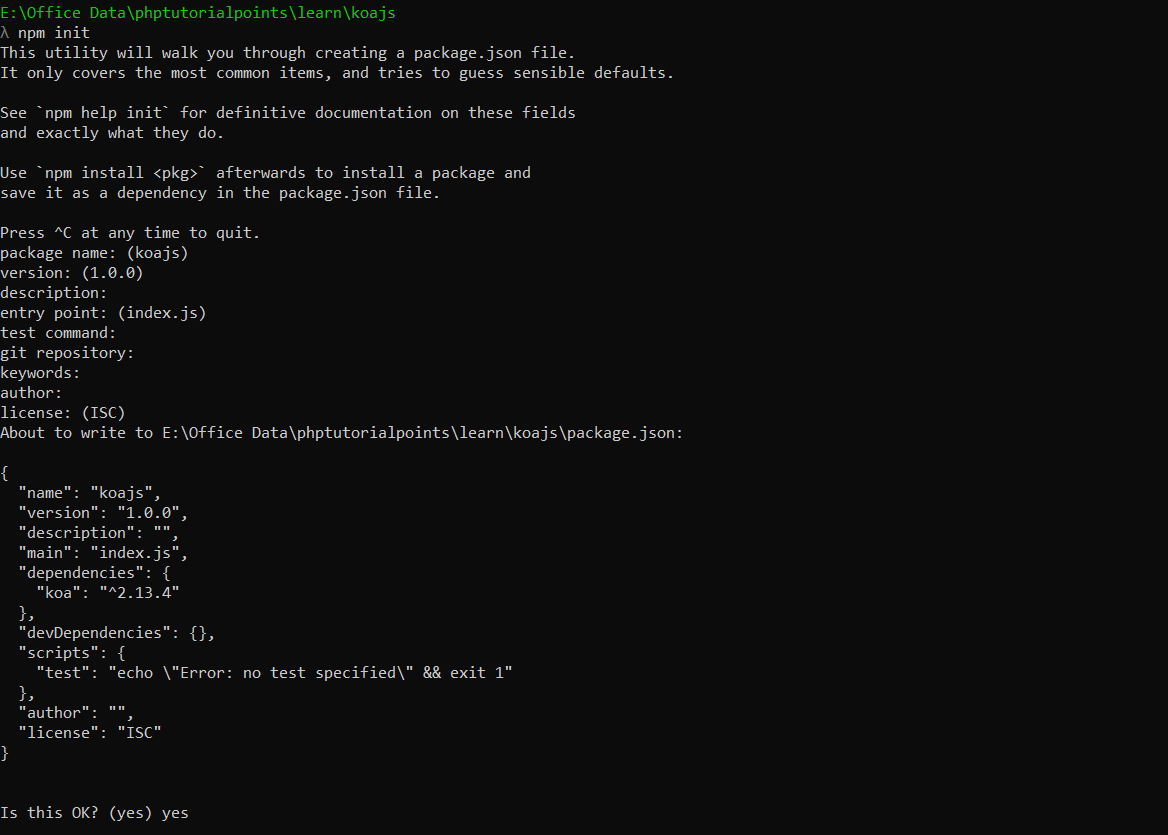
Step 1: Create a Project directory in your compute and create a simple node.js based project by running “npm init” command in your terminal
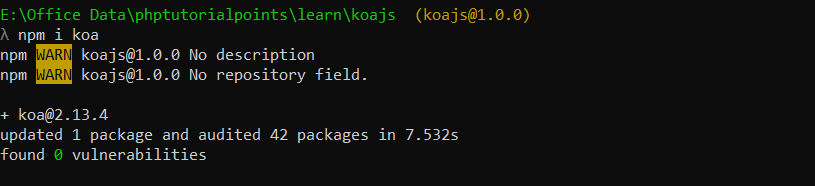
Step 2: After completing the above step, the “package.json” file is created in the project directory. Now, run “npm i koa” command in the terminal to install koa js in your project.
Step 3: Now, koa js is installed. Let’s create an “index.js” file in your project directory and write the below code in the file
var koa = require('koa');
var app = new koa();

app.use(function* (){
   this.body = 'Hello world!';
});

app.listen(3000, function(){
   console.log('Server running on https://localhost:3000')
});
Step 4: Now, your application is ready. To run the node.js based application, we’ll install it by running “npm install -g nodemon” command in your terminal. Once nodemon is installed, simply run “nodemon index.js” command in your terminal. you will see the following output in your browser:

Advantages and Disadvantages of Koa JS
Advantages:
- Koa is an innovative web framework created by the team responsible for making Express.
- It aims to be an expressive, smaller, and more powerful foundation for APIs and web applications.
- Koa enables developers to increase error handling to a great extent and ditch callbacks by using async functions.
Disadvantages:
- This framework is not known to bundle any type of middleware within it and offers an elegant set of procedures that help to make writing servers enjoyable and fast.
Koa.js Architecture
Koa follows a middleware-driven architecture:
Request → Middleware → Response
Each middleware:
- Can modify the request
- Pass control to the next middleware
- Handle the response
Koa.js vs Express.js
| Feature | Koa.js | Express.js |
|---|---|---|
| Middleware | Minimal | Built-in |
| Syntax | Async/Await | Callback-based (older) |
| Flexibility | High | Moderate |
| Size | Lightweight | Larger |
| Learning Curve | Medium | Easy |
Use Cases of Koa.js
Koa is ideal for:
- REST API development
- Microservices architecture
- Lightweight backend services
- Real-time applications
- Custom server frameworks
References
- Official Website: https://koajs.com/
- Node.js Official Docs: https://nodejs.org/
- Express.js Docs: https://expressjs.com/
Conclusion
Koa.js represents the next evolution of Node.js frameworks, focusing on simplicity, flexibility, and modern JavaScript practices. While it may not replace Express.js entirely, it provides a powerful alternative for developers who want full control over their backend architecture.
If you’re building modern APIs or microservices in 2026, Koa.js is definitely worth exploring.
Hope this article helps!