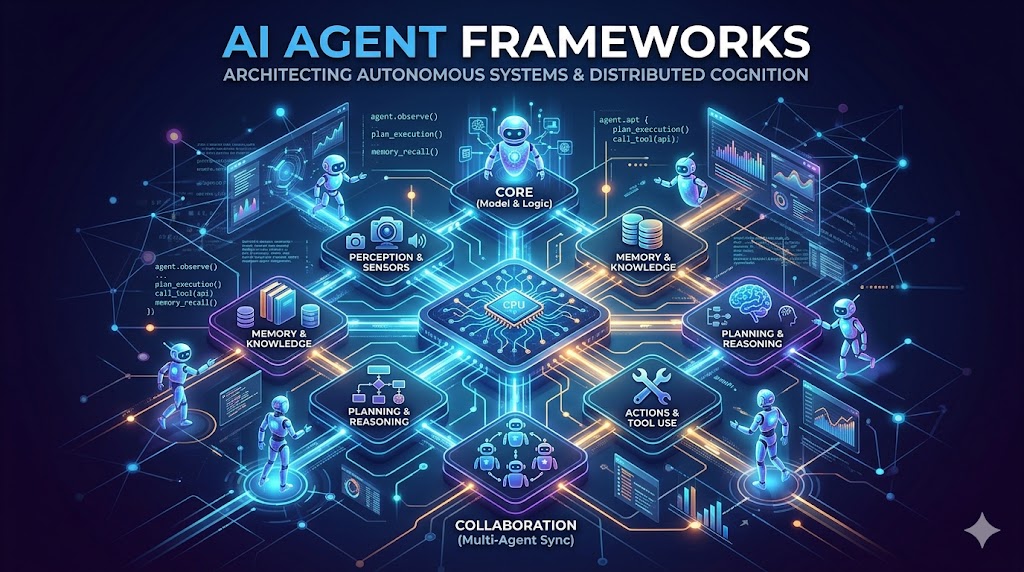
This article explores the top AI agent frameworks in 2026, including their features, architecture, use cases, advantages, limitations, and official references.
Table of Contents
Artificial Intelligence is rapidly evolving from simple chatbots into autonomous systems capable of reasoning, planning, tool usage, memory management, and multi-step execution. These systems are commonly called AI agents or agentic AI systems.
In 2026, AI agent frameworks have become one of the most important technologies for developers, startups, enterprises, and automation engineers. These AI agent frameworks help developers create AI-powered assistants that can:
- Use tools and APIs
- Perform autonomous actions
- Collaborate with other agents
- Maintain memory and context
- Execute workflows
- Reason step-by-step
- Automate business operations
From autonomous coding assistants to enterprise workflow automation, AI agent frameworks are transforming software development and digital operations.
What is an AI agent Framework?
An AI agentic framework is a software platform or library designed to build autonomous AI agents.
Unlike traditional AI applications that generate single responses, agentic frameworks enable AI systems to:
- Think iteratively
- Decide actions dynamically
- Use external tools
- Communicate with APIs
- Collaborate with multiple agents
- Store and retrieve memory
- Execute long-running workflows
Modern AI agents typically combine:
- Large Language Models (LLMs)
- Tool calling
- Retrieval systems
- Memory systems
- Workflow orchestration
- Reasoning loops
Why AI Agent Frameworks Matter
AI agent frameworks solve major challenges in building autonomous systems.
Benefits of AI Agent Frameworks
1. Faster Development
Developers can create complex AI systems without building orchestration logic from scratch.
2. Multi-Agent Collaboration
Some AI agent frameworks allow multiple agents to collaborate together.
3. Tool Integration
Agents can access APIs, databases, browsers, search engines, and local files.
4. Memory Management
AI agent Frameworks provide short-term and long-term memory support.
5. Workflow Automation
AI agents can execute multi-step workflows autonomously.
6. Human-in-the-Loop Support
Many AI agent frameworks allow humans to approve or intervene during execution.
7. Production Readiness
Modern frameworks include monitoring, observability, tracing, and deployment tools.
Core Features of Modern AI Agent Frameworks
Before selecting a framework, developers should understand the common capabilities available in modern agent systems.
| Feature | Description |
|---|---|
| Tool Calling | Connect APIs and external tools |
| Memory | Store conversation history and state |
| Planning | Multi-step task decomposition |
| Reasoning | Iterative decision making |
| Multi-Agent Collaboration | Multiple agents working together |
| Workflow Engine | Structured execution pipelines |
| Observability | Logging and tracing |
| Human Approval | Human validation during execution |
| RAG Integration | Retrieval-Augmented Generation |
| Stateful Execution | Resume interrupted tasks |
Top AI Agent Frameworks in 2026
1. LangChain and LangGraph
One of the most popular AI agent frameworks is LangChain.
LangChain is an open-source framework designed for building AI-powered applications and autonomous agents. According to the official documentation, LangChain provides pre-built agent architectures, tool integrations, middleware, and durable runtime support. (langchain.com)
LangChain agents combine language models with tools and iterative reasoning loops. The framework uses LangGraph internally to create graph-based execution flows. (LangChain Docs)
Key Features
- Agent orchestration
- Tool calling support
- Middleware architecture
- Human-in-the-loop workflows
- Durable execution runtime
- State persistence
- Checkpointing
- Graph-based workflows
- Multi-model support
- Extensive integrations
LangGraph
LangGraph is the lower-level orchestration engine behind LangChain agents.
It enables:
- Cyclic workflows
- Stateful graphs
- Agent collaboration
- Long-running execution
- Event-driven workflows
Advantages
- Huge ecosystem
- Excellent integrations
- Strong community adoption
- Flexible architecture
- Production-ready tooling
Limitations
- Learning curve can be steep
- Documentation changes rapidly
- Complex for beginners
Best Use Cases
- Enterprise AI systems
- AI copilots
- Workflow automation
- Autonomous research agents
- Coding assistants
Official Documentation
2. CrewAI
CrewAI is a rapidly growing open-source framework focused on multi-agent collaboration and enterprise workflow automation.
The official documentation describes CrewAI as a framework for orchestrating autonomous AI agents and structured workflows. (CrewAI Documentation)
CrewAI introduces two major concepts:
- Crews
- Flows
Crews
Crews are teams of autonomous agents collaborating to complete tasks.
Flows
Flows manage structured workflows, execution state, and orchestration.
Key Features
- Multi-agent collaboration
- Event-driven workflows
- State management
- Guardrails
- Human-in-the-loop support
- Enterprise deployment
- Structured outputs
- Memory systems
- Tool integrations
Advantages
- Excellent for collaborative agents
- Enterprise-friendly architecture
- Strong workflow capabilities
- Clean abstraction model
Limitations
- Smaller ecosystem compared to LangChain
- Advanced customization may require deeper understanding
Best Use Cases
- Enterprise automation
- AI research teams
- Autonomous business workflows
- Multi-agent customer support
- Internal productivity systems
Official Documentation
3. Microsoft AutoGen
AutoGen is a powerful multi-agent framework developed by Microsoft Research.
According to the research paper, AutoGen enables multiple AI agents to communicate and collaborate autonomously. (arXiv)
AutoGen agents can operate using:
- LLMs
- Human feedback
- External tools
- Custom orchestration logic
The framework focuses heavily on conversational agent collaboration.
Key Features
- Multi-agent communication
- Conversational workflows
- Tool usage
- Human-agent collaboration
- Flexible orchestration
- Code execution support
Advantages
- Excellent research foundation
- Strong multi-agent communication
- Highly flexible
- Great for experimental systems
Limitations
- More research-oriented
- Can become complex at scale
Best Use Cases
- Research assistants
- Autonomous coding agents
- Multi-agent reasoning systems
- AI experimentation
Official References
4. LlamaIndex
LlamaIndex started primarily as a RAG framework but has evolved into a powerful platform for agentic AI systems.
It specializes in connecting AI agents with external data sources.
Key Features
- Advanced RAG support
- Data indexing
- Agent workflows
- Tool calling
- Structured retrieval
- Knowledge graph integration
Advantages
- Excellent data connectivity
- Strong RAG ecosystem
- Good enterprise integration
Limitations
- More focused on data-centric agents
- Multi-agent support less mature than CrewAI
Best Use Cases
- Enterprise knowledge assistants
- AI search systems
- Document analysis
- Internal data copilots
Official Documentation
5. Haystack
Haystack is an open-source orchestration framework widely used for NLP pipelines and agentic workflows.
It provides modular pipelines and integrations for AI applications.
Key Features
- Pipeline orchestration
- Document retrieval
- Agent workflows
- Search integration
- API integrations
- Modular architecture
Advantages
- Mature NLP ecosystem
- Strong retrieval capabilities
- Good modular design
Limitations
- Smaller agent ecosystem
- Less focused on autonomous collaboration
Best Use Cases
- Search systems
- RAG applications
- AI document assistants
- Enterprise NLP workflows
6. Semantic Kernel
Semantic Kernel is Microsoft’s AI orchestration SDK.
It enables developers to combine prompts, memory, plugins, and planners.
Key Features
- Plugin architecture
- Memory integration
- Planning engine
- Enterprise integrations
- Native C# support
- Tool orchestration
Advantages
- Strong enterprise ecosystem
- Excellent Microsoft integration
- Secure architecture
Limitations
- Smaller open-source ecosystem
- More enterprise-oriented
Best Use Cases
- Enterprise copilots
- Microsoft ecosystem integrations
- Internal automation systems
7. OpenAI Agents SDK
OpenAI Platform provides modern APIs and SDKs for building autonomous AI agents.
Its ecosystem includes:
- Tool calling
- Function calling
- Structured outputs
- Memory support
- Agent workflows
Key Features
- Native OpenAI integration
- Tool calling
- Reasoning models
- Structured outputs
- API simplicity
Advantages
- Easy to start
- Reliable APIs
- Excellent model quality
Limitations
- Vendor dependency
- Less customizable than open frameworks
Best Use Cases
- Rapid AI prototyping
- SaaS products
- AI assistants
- Customer support systems
8. DSPy
DSPy GitHub is a framework for programming language model pipelines declaratively.
Instead of manually writing prompts, developers define system behavior programmatically.
Key Features
- Declarative programming
- Prompt optimization
- Reasoning pipelines
- Modular AI architecture
Advantages
- Research-friendly
- Optimized prompting
- Cleaner abstraction
Limitations
- Smaller ecosystem
- Advanced concepts for beginners
Best Use Cases
- AI research
- Experimental agents
- Optimization pipelines
Comparison of Popular AI agent Frameworks
| Framework | Multi-Agent | Workflow Engine | Memory | Enterprise Ready | Best For |
|---|---|---|---|---|---|
| LangChain | Yes | Yes | Yes | Yes | General AI agents |
| CrewAI | Yes | Yes | Yes | Yes | Multi-agent systems |
| AutoGen | Yes | Moderate | Yes | Moderate | Research workflows |
| LlamaIndex | Moderate | Yes | Yes | Yes | RAG agents |
| Haystack | Moderate | Yes | Moderate | Yes | Search pipelines |
| Semantic Kernel | Moderate | Yes | Yes | Yes | Enterprise AI |
| OpenAI SDK | Limited | Moderate | Moderate | Yes | Rapid prototyping |
| DSPy | Limited | Moderate | Limited | Moderate | Research optimization |
How to Choose an AI Agentic Framework
Selecting the right framework depends on project requirements.
Choose LangChain If
- You need maximum flexibility
- You want broad integrations
- You are building production AI systems
Choose CrewAI If
- You need collaborative agents
- You want workflow orchestration
- You are building enterprise automations
Choose AutoGen If
- You want advanced agent conversations
- You are experimenting with research systems
Choose LlamaIndex If
- Your application depends heavily on RAG
- You need advanced data retrieval
Choose Semantic Kernel If
- You work in Microsoft ecosystems
- You need enterprise-grade orchestration
Emerging Trends in Agentic AI Frameworks
The AI agent ecosystem is evolving quickly.
1. Multi-Agent Collaboration
Frameworks increasingly focus on collaborative agent teams.
2. Long-Term Memory
Persistent memory systems are becoming standard.
3. Human-in-the-Loop Systems
Human oversight is critical for enterprise AI.
4. Autonomous Workflows
Agents can now execute complex workflows independently.
5. Observability and Monitoring
Tracing and debugging tools are becoming essential.
6. Graph-Based Orchestration
Graph execution models are replacing linear pipelines.
Challenges of AI Agent Frameworks
Despite rapid innovation, several challenges remain.
Reliability
Agents can hallucinate or make incorrect decisions.
Cost
Long-running workflows consume large amounts of tokens.
Complexity
Multi-agent systems are difficult to debug.
Security Risks
Autonomous tool execution can introduce vulnerabilities.
Context Management
Managing long-term memory efficiently remains difficult.
Future of AI Agent Frameworks
The future of software development is increasingly agent-driven.
Over the next few years, AI agent frameworks are expected to include:
- Autonomous planning systems
- Self-improving agents
- Distributed agent networks
- Real-time collaboration
- Advanced memory architectures
- Native enterprise integrations
AI agents may eventually become digital coworkers capable of handling research, coding, operations, and business automation with minimal supervision.
Official References
- LangChain Official Website
- LangChain Documentation
- CrewAI Documentation
- AutoGen GitHub Repository
- AutoGen Research Paper
- LlamaIndex Official Website
- Haystack Official Website
- Semantic Kernel Documentation
- OpenAI Platform
- DSPy GitHub Repository
Official documentation and research references were used throughout this article. (langchain.com)
Conclusion
AI agentic frameworks are becoming essential technologies for developers building autonomous AI applications, workflow automation systems, and enterprise AI solutions.
Frameworks such as LangChain, CrewAI, AutoGen, and LlamaIndex provide advanced capabilities like multi-agent collaboration, reasoning workflows, memory systems, and tool integration. As businesses increasingly adopt generative AI and autonomous systems, understanding the best AI agent frameworks in 2026 can help developers create scalable and intelligent applications faster.
AI agent frameworks are redefining modern software development and automation.
Frameworks like LangChain, CrewAI, Microsoft AutoGen, and LlamaIndex provide developers with powerful tools for creating autonomous AI systems.
Each framework offers unique strengths:
- LangChain excels in flexibility and integrations
- CrewAI focuses on collaborative workflows
- AutoGen enables conversational multi-agent systems
- LlamaIndex specializes in RAG and data connectivity
As AI continues to evolve, agentic frameworks will become foundational technologies for enterprise automation, intelligent assistants, and autonomous digital systems.
Developers who learn these frameworks today will be well-positioned for the future of AI-powered software engineering.