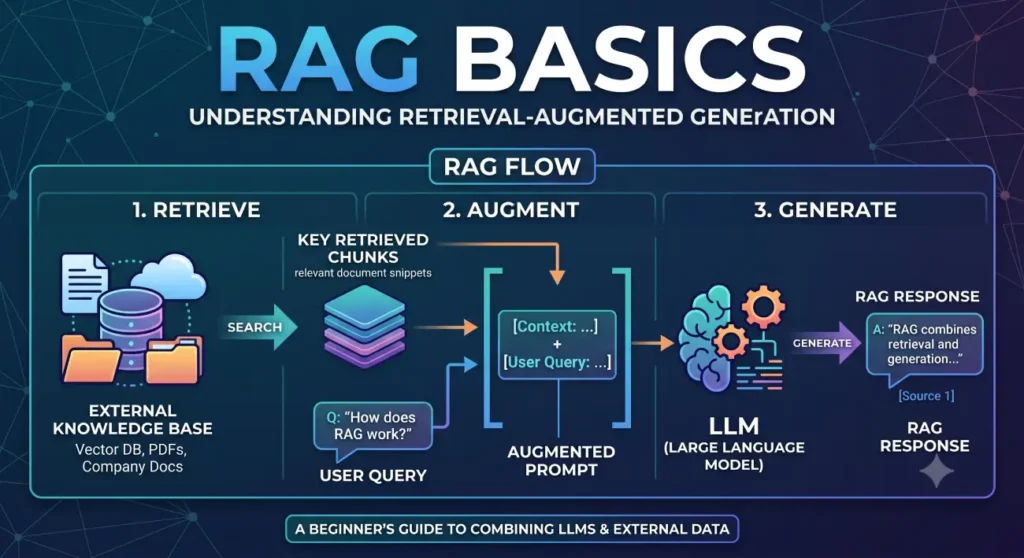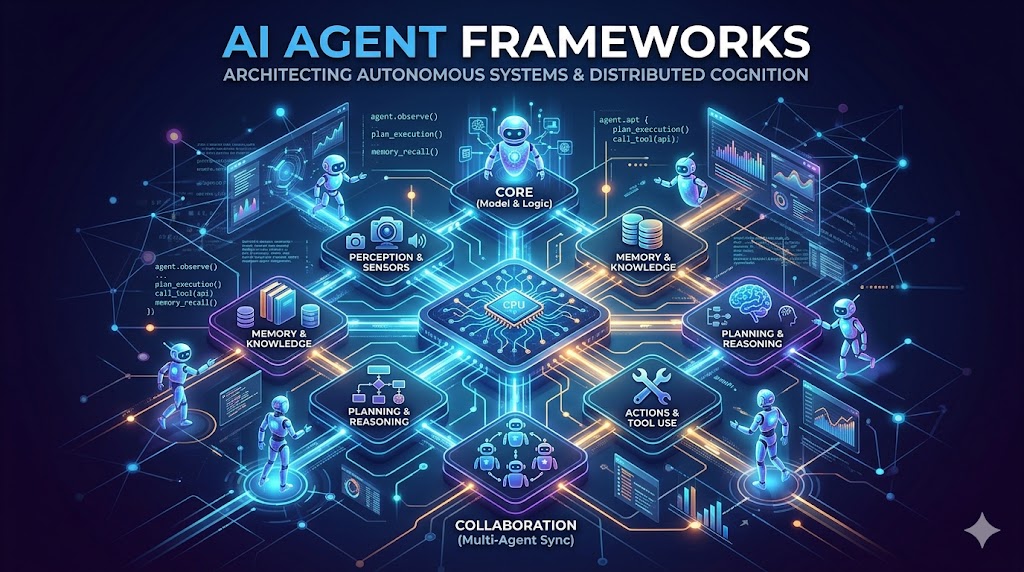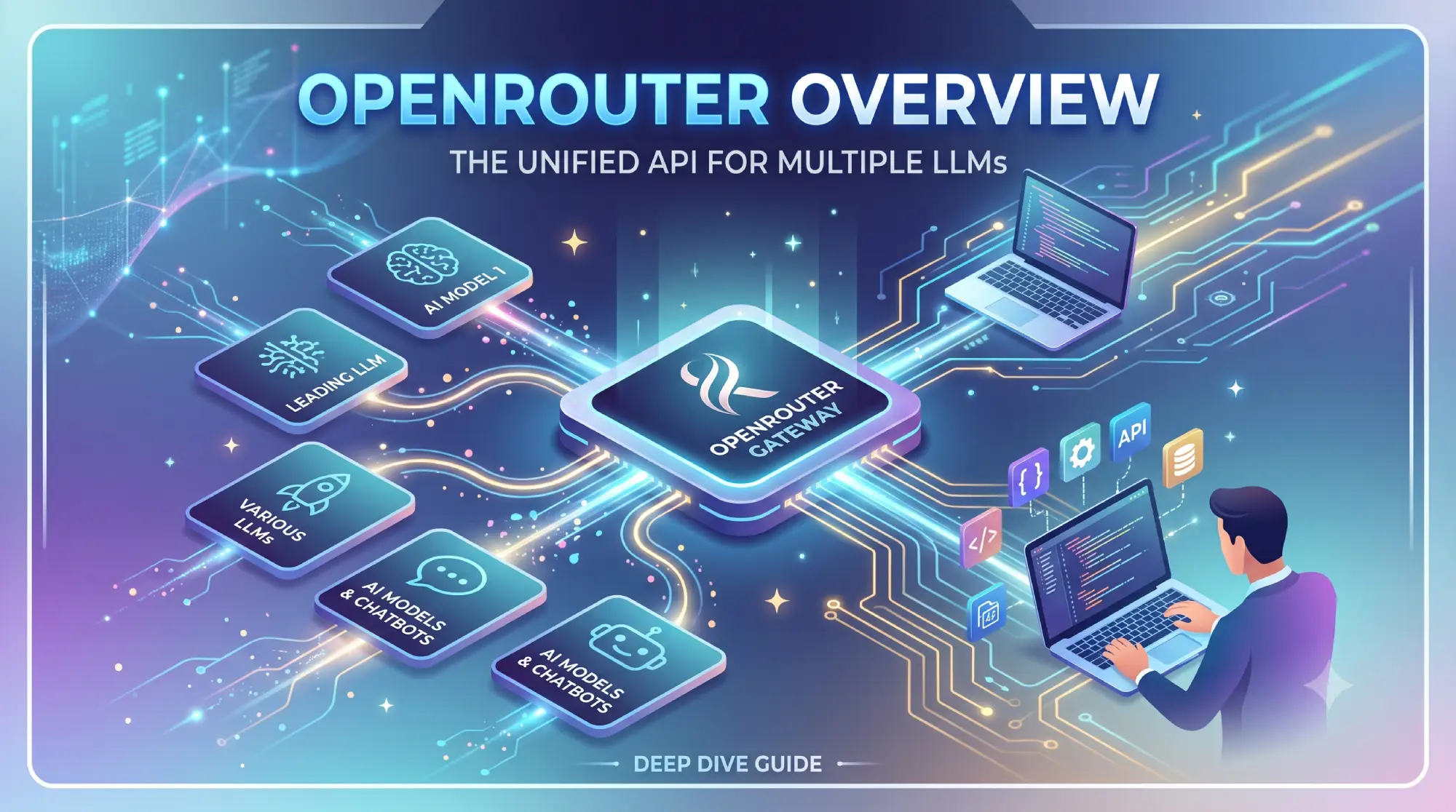
In this article, we’ll explore everything about OpenRouter, including its architecture, features, benefits, integrations, pricing, use cases, and why it has become a central hub for modern AI development.
Table of Contents
The Artificial Intelligence landscape is evolving at an extraordinary pace. Almost every month, new Large Language Models (LLMs) are being released by different companies. Developers today have access to powerful models such as GPT, Claude, Gemini, DeepSeek, Llama, Mistral, and many others. While this rapid innovation is exciting, it also introduces significant challenges.
Suppose you want to experiment with five different AI models. Traditionally, you would need to:
- Create separate accounts on different platforms
- Generate multiple API keys
- Learn different SDKs and documentation
- Understand different pricing models
- Handle rate limits and authentication mechanisms
- Maintain multiple integrations inside your applications
This process quickly becomes complicated, especially for students, startups, and developers who want to focus on building products instead of managing infrastructure.
This is where Open Router comes into the picture.
Open Router has emerged as one of the most useful platforms in the AI ecosystem because it provides a single gateway to hundreds of language models through one API key and one interface.
You can think of Open Router as:
“Zomato or Swiggy for Large Language Model APIs.”
Just as food delivery applications allow users to order from multiple restaurants using one account, OpenRouter enables developers to access hundreds of AI models through one unified platform.
In 2026, OpenRouter has become an essential tool for AI engineers, students, startups, researchers, and enterprises looking to simplify their AI development workflows.
What is OpenRouter?
Open Router is a unified API platform that provides access to hundreds of Large Language Models (LLMs) through a single API endpoint and API key.
Instead of integrating individually with different AI providers, developers can use OpenRouter as an abstraction layer that connects their applications to multiple models.
The platform supports models from various providers, including:
- OpenAI
- Anthropic
- Meta
- DeepSeek
- Mistral AI
- xAI
- Qwen
- Cohere
- Open-source communities
The primary objective of Open Router is to reduce complexity in AI application development.
With Open Router, developers can:
- Access hundreds of models
- Switch providers easily
- Compare model performance
- Experiment with new releases
- Use free and paid models
- Monitor usage and analytics
- Build applications using one unified API
Why Was OpenRouter Created?
The AI ecosystem is highly fragmented.
Every AI provider offers:
- Different authentication methods
- Different APIs
- Different rate limits
- Different pricing structures
- Different model capabilities
- Different SDKs
Managing these integrations can consume a significant amount of development time.
Open Router was created to solve these problems by providing:
- One API Key
- One API Endpoint
- One SDK Pattern
- One Dashboard
- Access to Hundreds of Models
This significantly reduces development friction and accelerates experimentation.
Understanding Open Router with a Simple Analogy
Imagine you want to order food.
Without food delivery applications:
- You visit Restaurant A’s website
- Create an account
- Enter payment information
- Repeat the same process for Restaurant B
- Repeat again for Restaurant C
This process is inefficient.
Food delivery applications solve this by aggregating restaurants into one platform.
OpenRouter works exactly the same way.
Without OpenRouter:
Application
    ↓
OpenAI API

Application
    ↓
Anthropic API

Application
    ↓
Google API

Application
    ↓
DeepSeek API
With OpenRouter:
Application
      ↓
OpenRouter API
      ↓
GPT
Claude
Gemini
Llama
DeepSeek
Mistral
Hundreds of Models
Your application only needs one integration.
How OpenRouter Works
The architecture of OpenRouter is relatively simple.
Step 1: Application Sends Request
Your application sends a prompt:
{
  "model": "openai/gpt-5",
  "messages": [
    {
      "role": "user",
      "content": "Explain recursion."
    }
  ]
}
Step 2: OpenRouter Receives Request
OpenRouter:
- Authenticates request
- Verifies API key
- Identifies requested model
- Performs routing
Step 3: Request Forwarding
OpenRouter forwards the request to the selected provider.
For example:
User Application
       ↓
OpenRouter
       ↓
GPT-5
or
User Application
       ↓
OpenRouter
       ↓
Claude
Step 4: Response Delivery
The provider generates the response and OpenRouter sends it back to your application.
The developer experiences a consistent API interface regardless of the model provider.
Key Features of OpenRouter
1. Unified Access to Hundreds of Models
One of the biggest advantages of OpenRouter is unified access.
Developers can switch between models by changing only the model identifier.
Example:
model: "anthropic/claude"
or
model: "google/gemini"
or
model: "meta-llama/llama"
No major code changes are required.
This dramatically simplifies experimentation and development.
2. Single API Key
Traditional approach:
OpenAI API Key
Claude API Key
Google API Key
DeepSeek API Key
Mistral API Key
OpenRouter approach:
One API Key
This simplicity reduces operational overhead and makes environment management significantly easier.
Example:
OPENROUTER_API_KEY=your_key
3. Access to Free Models
A major reason for OpenRouter’s popularity among students and hobbyists is the availability of free models.
Many models can be used without incurring high costs.
Benefits include:
- Learning AI development
- Building side projects
- Experimentation
- Rapid prototyping
- Educational projects
- Academic research
Students can practice prompt engineering and AI application development without worrying about expensive API bills.
4. Early Access to New Models
AI providers frequently release:
- Alpha models
- Preview versions
- Beta releases
- Experimental reasoning models
OpenRouter often provides access to these models early.
This is particularly beneficial for:
- Researchers
- AI startups
- Developers building cutting-edge products
- Technology enthusiasts
Early access allows teams to evaluate capabilities before official public releases.
5. Model Playground
The OpenRouter Playground is one of its most useful features.
Developers can:
- Test prompts
- Compare outputs
- Analyze reasoning
- Measure response quality
- Evaluate code generation
Instead of writing test applications, developers can instantly experiment within the browser.
Example
Prompt:
Create a REST API in Node.js.
Run the prompt against:
- GPT
- Claude
- Gemini
- DeepSeek
- Llama
Then compare:
- Accuracy
- Code quality
- Performance
- Reasoning
- Documentation
This significantly improves model selection decisions.
6. Side-by-Side Model Comparison
Different models excel at different tasks.
Some are excellent at:
- Coding
- Reasoning
- Mathematics
- Summarization
- Translation
- Long-context processing
OpenRouter allows direct comparisons.
This helps developers answer questions like:
- Which model generates better code?
- Which model is more cost-effective?
- Which model is faster?
- Which model follows instructions better?
7. Transparent Analytics
OpenRouter offers detailed analytics and leaderboards.
Metrics include:
- Token usage
- Input cost
- Output cost
- Response latency
- Availability
- Performance rankings
These insights help developers make informed decisions.
OpenRouter Leaderboards
Leaderboards provide transparency across models.
They typically include:
Intelligence Rankings
Measures:
- Reasoning capability
- Problem solving
- Benchmark performance
Speed Rankings
Measures:
- Response latency
- Token generation speed
Cost Rankings
Measures:
- Price per token
- Affordability
Leaderboards help answer important questions:
Which model is smartest?
Which model is fastest?
Which model provides the best value?
OpenRouter Integrations
One of OpenRouter’s greatest strengths is compatibility with existing frameworks.
OpenAI SDK
Developers already using the OpenAI SDK can integrate OpenRouter with minimal changes.
Example:
const client = new OpenAI({
  baseURL: "https://openrouter.ai/api/v1",
  apiKey: process.env.OPENROUTER_API_KEY
});
Most application code remains unchanged.
LangChain Integration
OpenRouter integrates seamlessly with LangChain.
Benefits include:
- Agent development
- RAG systems
- Memory systems
- Workflow automation
- Multi-agent applications
This makes OpenRouter attractive for enterprise AI projects.
AI Agent Frameworks
Open Router works well with:
- LangChain
- LangGraph
- CrewAI
- AutoGen
- LlamaIndex
Developers can build sophisticated AI applications without vendor lock-in.
Why Developers Love OpenRouter
Vendor Independence
Applications are not tied to a single provider.
Developers can switch models easily.
Reduced Complexity
One integration replaces multiple integrations.
Faster Experimentation
Testing new models takes minutes rather than days.
Easier Maintenance
Only one API configuration must be managed.
Better Cost Optimization
Developers can choose models according to budget requirements.
Open Router for Students
Students often face several challenges:
- Expensive APIs
- Limited budgets
- Complex documentation
- Multiple account management
Open Router addresses these problems.
Students can:
- Learn prompt engineering
- Build AI chatbots
- Develop AI agents
- Create portfolio projects
- Experiment with new models
It lowers the barrier to entry into AI development.
Open Router for Startups
Startups require:
- Speed
- Flexibility
- Cost control
- Scalability
OpenRouter delivers all four.
Startups can:
- Build MVPs quickly
- Experiment with multiple models
- Optimize costs
- Switch providers when necessary
This flexibility is extremely valuable during product development.
Real-World Use Cases
AI Chatbots
Applications can dynamically select different models.
Coding Assistants
Use the best coding model for code generation tasks.
Content Generation
Generate:
- Articles
- Marketing copy
- Emails
- Documentation
Customer Support Systems
Provide intelligent responses using multiple models.
Research Assistants
Leverage advanced reasoning models for complex queries.
Educational Applications
Build tutoring systems using free and paid models.
AI Agents
Develop autonomous systems capable of:
- Planning
- Tool calling
- Information retrieval
- Workflow execution
Benefits of Using OpenRouter
Simplified Development
One integration instead of many.
Reduced Learning Curve
Developers learn one API pattern.
Lower Costs
Access free models and optimize expenses.
Future-Proof Architecture
New models can be adopted quickly.
Rapid Innovation
Experiment with cutting-edge AI capabilities.
Better Decision Making
Analytics and leaderboards provide valuable insights.
Potential Limitations
Although Open Router offers numerous advantages, developers should understand its limitations.
Third-Party Dependency
Applications rely on OpenRouter’s infrastructure.
Provider Availability
Model availability depends on provider status.
Changing Model Landscape
Models evolve rapidly and rankings may change.
Learning Model Selection
Having access to hundreds of models can initially feel overwhelming.
However, these limitations are generally outweighed by the productivity benefits.
Best Practices for Using Open Router
Start with Free Models
Experiment before spending money.
Compare Models
Use the playground regularly.
Monitor Analytics
Track costs and performance.
Build Provider-Agnostic Applications
Avoid assumptions tied to one specific model.
Use Environment Variables
OPENROUTER_API_KEY=your_api_key
Test Multiple Models
Different tasks require different capabilities.
Who Should Use OpenRouter?
Open Router is suitable for:
Students
Learning AI development.
Hobby Developers
Building side projects.
Startups
Creating MVPs rapidly.
Researchers
Testing experimental models.
Enterprises
Managing multi-model AI applications.
AI Engineers
Building production systems with flexibility.
The Future of Open Router
The AI industry is becoming increasingly multi-model.
Organizations rarely rely on a single provider anymore.
Future AI systems will likely:
- Route requests dynamically
- Choose models based on task complexity
- Optimize costs automatically
- Use multiple providers simultaneously
Platforms like Open Router are well-positioned to become the infrastructure layer powering this multi-model ecosystem.
As hundreds of new models continue to emerge, developers need a centralized gateway that simplifies experimentation and deployment.
Open Router addresses exactly this challenge.
References
- Official OpenRouter Documentation
- Official OpenRouter API Reference
- Open Router Model Directory
- Open Router Playground
- OpenAI API Documentation
- Anthropic Claude Documentation
- Google Gemini API Documentation
- Meta Llama Documentation
- LangChain Documentation
- LlamaIndex Documentation
- OpenAI SDK Documentation
- AI Agent Framework Documentation (CrewAI, LangGraph, AutoGen)
Conclusion
Open Router has established itself as one of the most useful tools in the modern AI ecosystem by providing a unified gateway to hundreds of Large Language Models through a single API.
Much like how food delivery applications aggregate restaurants into one convenient platform, OpenRouter consolidates AI providers and removes the complexity of managing multiple accounts, SDKs, and integrations. Developers can access models like GPT, Claude, Gemini, Llama, DeepSeek, and many others using one API key and one consistent interface.
For students, Open Router provides access to numerous free models that make learning AI development affordable and accessible. For startups and enterprises, it offers flexibility, faster experimentation, cost optimization, and freedom from vendor lock-in. Features such as the Playground, side-by-side model comparisons, leaderboards, analytics, and integrations with frameworks like LangChain and the OpenAI SDK further enhance developer productivity.
As the AI ecosystem continues to expand and become increasingly multi-model, platforms like OpenRouter will play a crucial role in simplifying AI development. Instead of spending time managing infrastructure and multiple provider integrations, developers can focus on what truly matters—building innovative AI-powered applications.
In 2026 and beyond, Open Router is not merely an API aggregator; it is becoming an essential development platform and a single point of entry into the rapidly evolving world of Artificial Intelligence.