PHP has been a cornerstone of web development for decades, and even in 2026, Core PHP remains a powerful and flexible choice for building dynamic web applications.
Table of Contents
While modern PHP frameworks, such as Laravel and Symfony, have gained popularity, Core PHP continues to thrive due to its simplicity, performance, and versatility. To stay ahead in 2026, Core PHP developers need to leverage the right PHP tools and libraries to streamline development, enhance security, and improve performance.
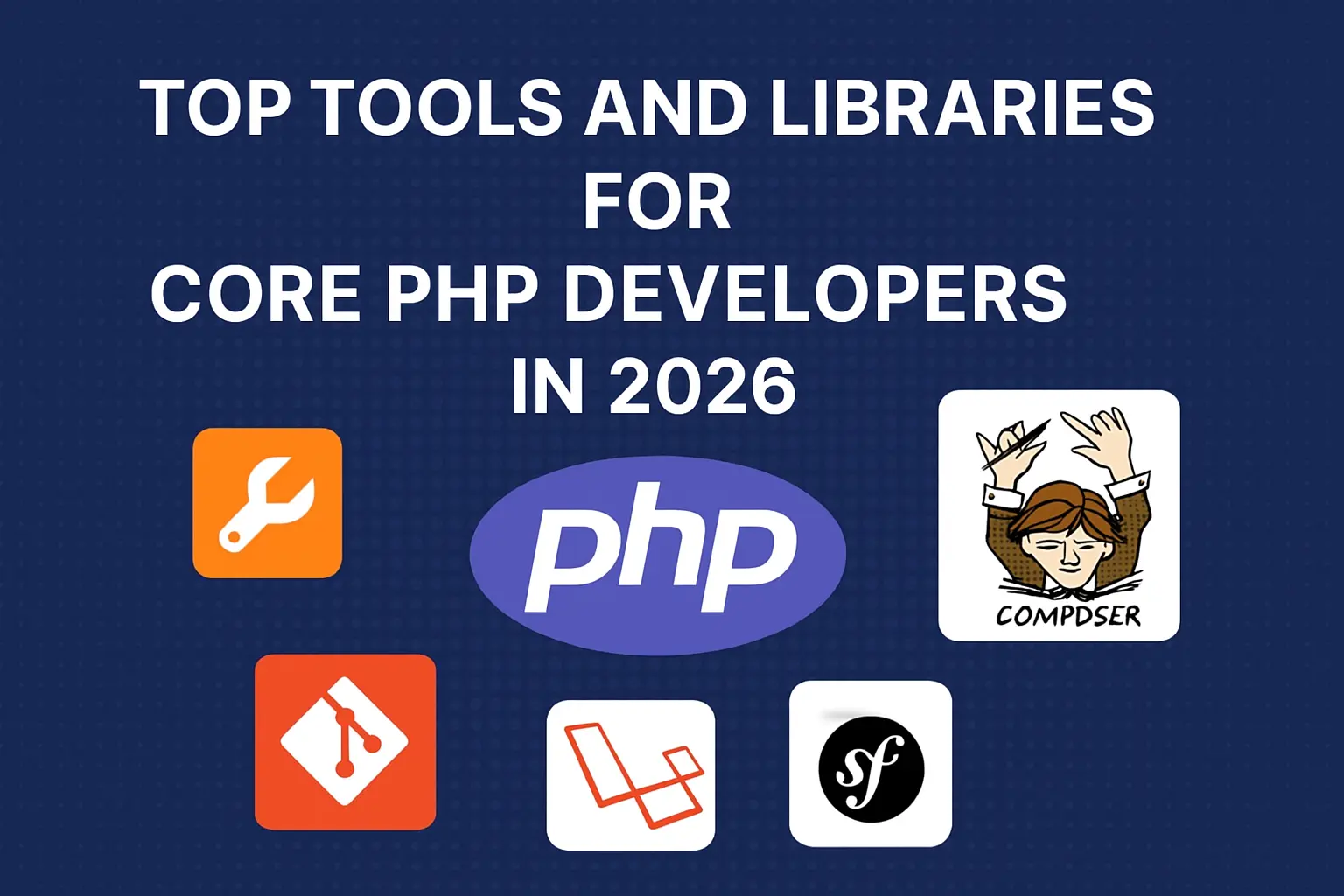
In this article, we’ll explore the top PHP tools and libraries that every Core PHP developer should consider using in 2026. These PHP tools will help you write cleaner code, debug efficiently, and build robust applications. Whether you’re a beginner or an experienced developer, this guide will help you stay updated with the latest PHP development trends.
1. Composer: The PHP Dependency Manager
Composer is an essential tool for PHP developers, even in 2026. It simplifies dependency management, allowing you to install and update libraries and packages effortlessly. With Composer, you can integrate third-party libraries into your Core PHP projects without manually managing files.
Why Use Composer in 2026?
- Automates Dependency Resolution: Composer automatically resolves and installs the required dependencies for your project.
- PSR-4 Autoloading: It supports PSR-4 autoloading, which helps you organize your code into namespaces and autoload classes without manual require statements.
- Access to Packagist: Composer connects to Packagist, a repository of over 300,000 PHP packages.
Example Usage:
To install a package like Monolog (a logging library), run the following command in your terminal:
composer require monolog/monolog
This command:
- Downloads the Monolog library.
- Updates the composer.json file with the dependency.
- Autoloads the library so you can use it in your project.
Syntax Breakdown:
- composer require: The command to install a package.
- monolog/monolog: The package name in the format vendor/package.
2. PHPStan: Static Code Analysis Tool
PHPStan is a powerful static analysis tool that helps developers catch bugs and errors in their code before runtime. In 2025, as applications grow more complex, PHPStan ensures your Core PHP codebase remains clean and maintainable.
Why Use PHPStan in 2026?
- Type Safety: PHPStan checks for type mismatches, ensuring your code adheres to strict typing.
- Custom Rules: You can define custom rules to enforce coding standards specific to your project.
- CI/CD Integration: PHPStan integrates seamlessly with continuous integration pipelines, making it ideal for team projects.
Example Usage:
To analyze your src directory, run:
vendor/bin/phpstan analyse src
This command:
- Scans the src directory for PHP files.
- Reports errors like undefined variables, unused code, and type mismatches.
Syntax Breakdown:
- vendor/bin/phpstan: The path to the PHPStan executable.
- analyse: The command to start the analysis.
- src: The directory to analyze.
3. Monolog: Logging Library
Monolog is a logging library that simplifies logging in PHP applications. It supports multiple handlers, such as files, sockets, and external services like Slack or Elasticsearch. In 2026, logging remains critical for debugging and monitoring.
Why Use Monolog in 2026?
- Multiple Handlers: Log to files, databases, or external services.
- Structured Logging: Store logs in JSON format for easier analysis.
- PSR-3 Compliance: Monolog follows the PSR-3 logging standard, ensuring compatibility with other libraries.
Example Usage:
use Monolog\Logger;
use Monolog\Handler\StreamHandler;

// Create a log channel
$log = new Logger('name');
$log->pushHandler(new StreamHandler('path/to/your.log', Logger::WARNING));

// Add a log message
$log->warning('This is a warning message.');
This code:
- Creates a logger instance.
- Adds a handler to log messages to a file.
- Logs a warning message.
Syntax Breakdown:
- Logger: The main class for creating log channels.
- StreamHandler: A handler to write logs to a file.
- warning(): A method to log a warning-level message.
4. Guzzle: HTTP Client Library
Guzzle is a powerful HTTP client for making HTTP requests and integrating with APIs. In 2026, as microservices and APIs dominate the web, Guzzle remains a must-have library for Core PHP developers.
Why Use Guzzle in 2026?
- Simplifies API Integration: Easily send GET, POST, PUT, and DELETE requests.
- Asynchronous Requests: Perform non-blocking HTTP requests.
- Middleware Support: Add custom logic to requests and responses.
Example Usage:
use GuzzleHttp\Client;

$client = new Client();
$response = $client->request('GET', 'https://api.example.com/data');
echo $response->getBody();
This code:
- Creates a Guzzle client.
- Sends a GET request to an API endpoint.
- Outputs the response body.
Syntax Breakdown:
- Client: The main class for making HTTP requests.
- request(): A method to send HTTP requests.
- getBody(): Retrieves the response body.
5. Rector: Automated Code Refactoring
Rector has emerged as a game-changer for 2026. It is a tool that automatically upgrades and refactors your code. Instead of manually updating old array syntax or upgrading from PHP 8.2 to PHP 8.4, Rector does it for you instantly.
Why Use Rector in 2026?
-
Instant Upgrades: Automatically upgrades code to leverage the newest PHP features (e.g., changing switch statements to match expressions).
-
Dead Code Removal: Automatically finds and removes unused variables and methods.
-
Architectural Improvements: Can refactor procedural code into modern patterns.
Example Usage
To upgrade your code to PHP 8.4 standards automatically:
vendor/bin/rector process src
6. Pest: The Elegant Testing Framework
While PHPUnit remains the industry giant, Pest has taken the spotlight in 2025-2026 for its developer experience. Built on top of PHPUnit, Pest offers a cleaner, more expressive syntax that makes writing tests a joy rather than a chore.
Why Use Pest in 2026?
-
Minimal Syntax: Removes the boilerplate of classes and methods found in traditional PHPUnit tests.
-
Readable Output: Offers beautiful console output that makes debugging failed tests easier.
-
Parallel Execution: Runs tests faster by utilizing all CPU cores.
Example Usage
test('basic addition', function () {
    expect(2 + 2)->toBe(4);
});
Syntax Breakdown
-
test(): Defines the test description.
-
expect(): A fluent assertion API that reads like plain English.
7. Respect/Validation – Best Validation Library for Core PHP
Validating user input is essential for security.
Example
use Respect\Validation\Validator as v;

v::email()->validate("test@example.com"); // true
8. Carbon – The Best PHP Date & Time Library
Working with date and time is now simpler than ever.
Example
use Carbon\Carbon;

echo Carbon::now()->addDays(5)->toDateTimeString();
9. JWT (Firebase JWT) – Secure Authentication
JWT tokens are essential for modern login systems, especially APIs.
Example
$token = JWT::encode(['id' => 1], 'secret_key');
References:
- Composer Official Documentation
- PHPStan GitHub Repository
- Monolog GitHub Repository
- PHPUnit Official Documentation
- Guzzle GitHub Repository
Conclusion
In 2026, Core PHP continues to be a reliable choice for web development, especially when paired with the right PHP tools and libraries. From dependency management with Composer to debugging with Symfony VarDumper, these PHP tools empower developers to build efficient, secure, and maintainable applications.
By staying updated with the latest PHP development trends and leveraging these best PHP libraries for developers, you can remain competitive in the ever-evolving tech landscape.